

Most AI pilots are picked because they’ll look good in a steering committee. The ones that reach production tend to be duller: frequent, measurable, owned, and close to the systems people already use. Here’s how to choose a first workflow that can survive the trip, with a scorecard you can run on your shortlist this week.
Series – this is part 1 of 4 in Pilot to Production, our practical guide to getting an AI workflow live and keeping it there. Part 2: The Pilot Worked. Now Build It Like Someone Will Rely on It. Part 3: Prove Your AI Workflow Works Before You Switch It On. Part 4: Your AI Workflow Is Live. Who’s Watching It, and What Comes Second?
At the end of October, two of Britain’s biggest banks told the market what their AI was doing in production. Neither picked anything you’d put in a keynote. On 26 October Lloyds said an agentic AI platform had supported its fraud specialists across “more than 10,600 live customer cases in 90 days”, helping them investigate suspected debit card fraud. Four days later NatWest’s third-quarter statement reported that its “AI fraud-triage agent in Cora has supported 52,000 credit card customer conversations.”
Read how Lloyds describes its platform and you’ll find most of what this article argues for. The work happens thousands of times a quarter. It was measured: the bank tested “its outputs against completed case outcomes”, and decision accuracy rose “to over 90% in September” after 50 improvements across seven updates. It plugs into the work people already do, roughly halving the systems a specialist needs during a call, from a process that once spanned “12 to 15 systems”. And a person stays in charge: “Trained fraud specialists review the evidence and suggested actions and remain accountable for the customer decision.” Overrides of the platform’s recommendations have fallen by 30%.
NatWest’s agent does one narrow job inside Cora, the assistant its customers already use. In the same quarter, the bank started a trial of a broader AI Spending Insights tool. The narrow job is live at scale. The broader one is still being tried.
They aren’t outliers. The Bank of England and FCA’s 2026 survey of AI in UK financial services, published the same week with 196 firms responding, found AI “concentrated in Operations and IT”, at “approximately 31% of all reported AI systems”. 80% of respondents had AI agents in production providing decision support, where “AI agents recommend actions, humans decide and execute”. Only 2% had deployed agents with broad autonomy.
What’s actually in production is narrow, frequent, and checked by a person. The ambitious projects come later, built on what the first one proves.
Why the Wrong Pilots Get Picked
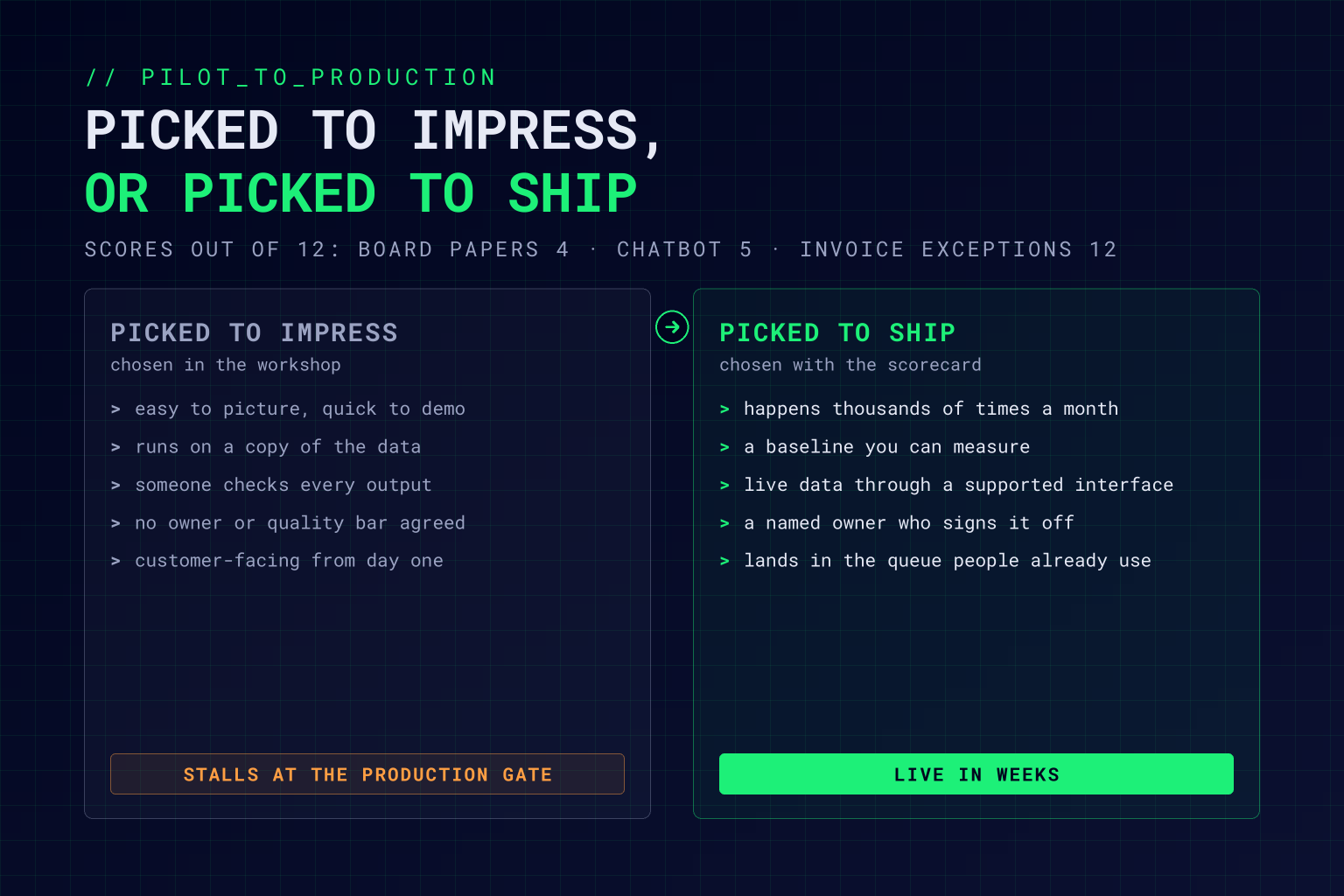
Pilots get chosen in workshops, and workshops reward what’s easy to picture. A chatbot that answers questions about the HR policy. A tool that drafts board papers. A demo where the model reads a contract and flags the risky clause. Each one is easy to explain and quick to show, and that’s exactly the problem.
The pilot runs on a copy of the data, in a sandbox, with someone checking every output. Nobody has to agree who owns it, what a good result looks like, or what happens when it’s wrong. Those questions all arrive at once, at the production gate, and that’s where most pilots stop. Deloitte’s State of AI in the Enterprise 2026 found that only 25% of organisations have moved 40% or more of their AI pilots into production, and that the companies seeing the most success start “with lower-risk use cases”. We’ve written about why pilots die, and why the honest measure of an AI programme is the number of workflows it has running rather than the number of pilots. This series is about the how.
A pilot chosen for the demo has to be chosen all over again for production. Most never are.
Six Tests for a First Workflow
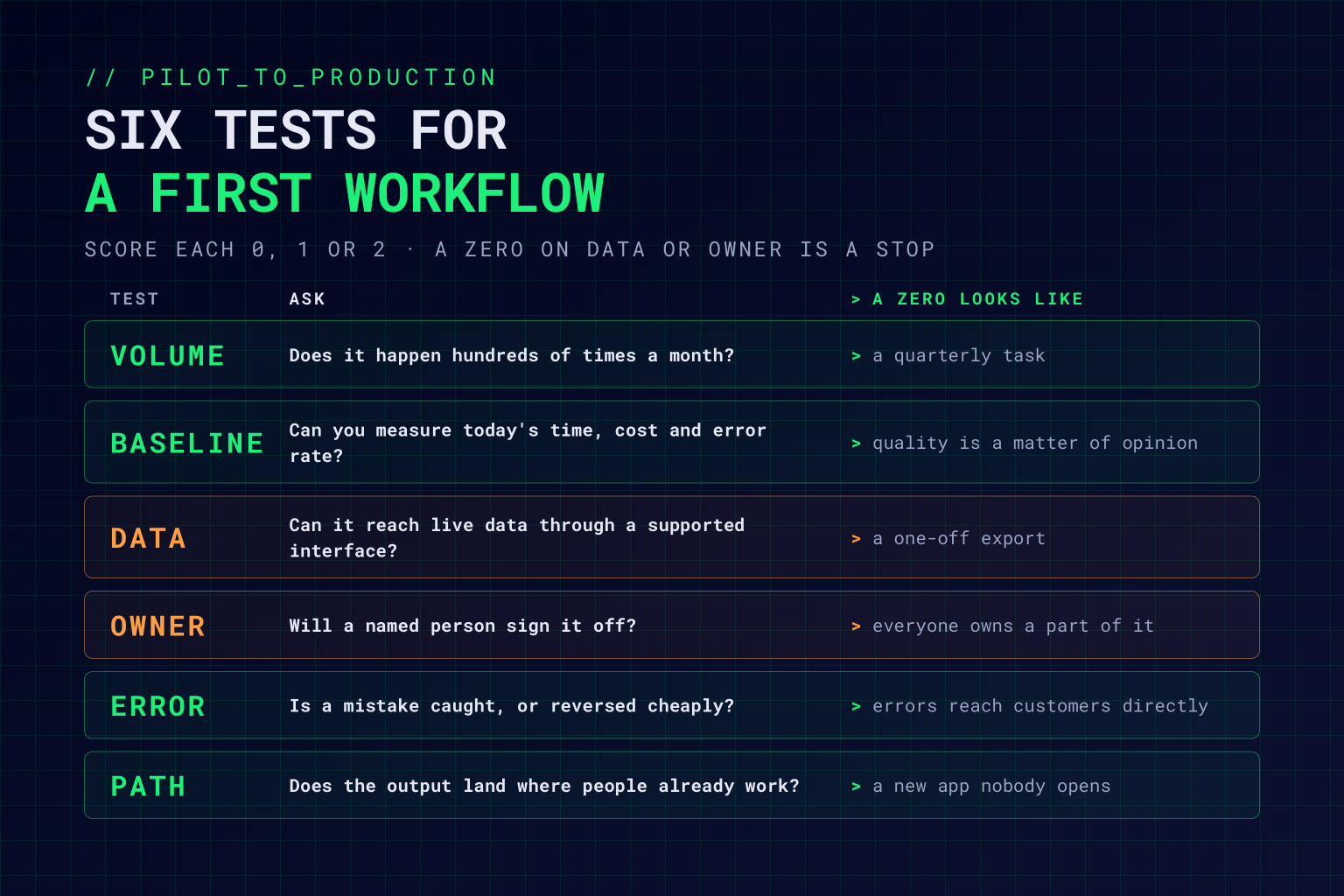
Put every candidate through six tests before anything gets built. A workflow doesn’t have to ace all six. A fail on the owner or the data, though, usually means it won’t ship.
Volume. Does it happen hundreds or thousands of times a month? A small saving on frequent work adds up quickly. A big saving on a quarterly task won’t pay for the platform it needs.
A measurable outcome with a baseline. Can you say today how long the work takes, what it costs, and how often it goes wrong? Without a baseline you’ll never be able to show the AI version is better, and someone in finance will eventually ask.
Data you can reach in production. Not a one-off export. The live system, through an interface you’re allowed to use, with the access and retention rules that already apply to it.
An owner and an approval chain. A named person who answers for the outcome and will sign the workflow off. If nobody will put their name to the result, the workflow isn’t ready to be picked.
Tolerance for error. What happens when it’s wrong? Start where a mistake gets caught before it reaches a customer, or can be reversed cheaply. Leave the irreversible decisions for workflow three or four.
A path into the tools people already use. The output has to land in the case system, the ERP, or the queue people already work from. A separate app that people have to remember to open is a pilot that never ends.
Score the Shortlist
Score each candidate 0, 1 or 2 on every test. A 2 means you could show the evidence today. A 1 means it’s partly there. A 0 means nobody knows, or nobody owns it. Here’s how three typical candidates come out:
| Test | Board-paper drafting | Supplier invoice exceptions | Customer-facing chatbot |
|---|---|---|---|
| Volume | 0 – a handful a month | 2 – thousands a month | 2 – thousands a month |
| Outcome and baseline | 0 – quality is a matter of opinion | 2 – time per exception, error rate, late-payment cost | 1 – deflection rate, but a thin satisfaction baseline |
| Data in production | 1 – scattered across drives and inboxes | 2 – ERP records and invoice images | 1 – a knowledge base nobody’s updated |
| Owner and approval | 1 – the company secretary, reluctantly | 2 – the accounts payable lead | 0 – marketing, service and IT each own a part |
| Tolerance for error | 1 – someone rewrites it anyway | 2 – a person approves every payment | 0 – mistakes reach customers directly |
| Path into existing tools | 1 – a document someone pastes in | 2 – lands in the ERP work queue | 1 – needs a new channel and handover |
| Total out of 12 | 4 | 12 | 5 |
Nobody’s going to clap at a demo of invoice exceptions. That’s rather the point. It’s the one you could have live in weeks, and the one that’ll give you the evidence, the controls, and the confidence to take on the chatbot later.
The best first workflow is usually the easiest one to measure, not the easiest one to imagine.
Where Good First Workflows Hide
They tend to sit in the middle of the business, in work that’s already checked by a person and already lands in a system of record. A few we’d look at first:
Financial services: complaint triage and first-draft responses, KYC document checks, and call summaries written straight into the CRM.
Insurance: first notification of loss intake, and pulling the facts out of claims documents so handlers start with a summary rather than a pile of attachments.
Professional services: tidying time narratives before billing, preparing conflict checks, and first drafts built only from approved precedent.
Retail: supplier invoice and price-file exceptions, and filling the gaps in product data before it reaches the website.
Logistics: proof-of-delivery exceptions, and checking customs paperwork against the shipment record.
Write the One-Page Case Before Anyone Builds
Before the build starts, get five things onto one page: the owner, the baseline, the quality bar for a good result, the costs you’ll count against it, and the result that would make you stop. The quality bar matters most. In our cost-per-outcome model we count only the outcomes that stick, such as a ticket that isn’t reopened within seven days. Agree that bar before anyone has seen a number, or the number will quietly move to meet the result.
The stop condition matters nearly as much. A pilot with no exit criteria doesn’t end, it just stops getting attention. Write down what “not worth it” looks like, and who gets to call it.
Then the hard part starts. Part 2 covers what a pilot gets away with and production can’t: real integrations, scoped data access, an identity of its own, guardrails, human approvals, an audit trail, and a way to switch it off.
Q&A: Choosing Your First AI Workflow
What makes a good first AI use case?
One that happens often, has a measurable outcome and a baseline, runs on data you can reach in production, has a named owner who’ll sign it off, tolerates the occasional error because a person checks the result, and lands in a system people already use.
Why do most AI pilots fail to reach production?
Because they’re chosen for how well they demo. Pilots run on copied data, in a sandbox, with someone checking every output, so the questions that decide production, such as ownership, data access, quality and what happens when it’s wrong, only arrive at the production gate.
How do you prioritise AI use cases?
Score each candidate 0, 1 or 2 against six tests: volume, a measurable outcome with a baseline, data you can reach in production, an owner and approval chain, tolerance for error, and a path into existing tools. Treat a zero on the owner or the data as a stop, whatever the total.
Should your first AI use case be customer-facing?
Usually not. Start where a person already checks the output and a mistake can be caught or reversed cheaply. If it does face customers, keep it to one narrow job inside a channel they already use, with a clear hand-off to a person, and build the broader customer-facing work on the controls and evidence that first workflow gives you.
What should an AI use case business case include?
Five things on one page: the owner, today’s baseline, the quality bar for a good result, the full cost you’ll count against it including people’s time, and the result that would make you stop. Agree the quality bar before anyone sees the numbers.
Working Through This With Vertex Agility
As an AI-native transformation consultancy, we help organisations get AI out of the pilot stage and into the work. Our AI Use Case Factory finds, validates, and scales use cases against measurable outcomes, and our AI Readiness Diagnostic gives you a prioritised list of use cases with their ROI and risk in two weeks. Our AI Consultancy practice works across the major model providers, so the advice is about the workflow, not a product.
If you’re choosing your next pilot, our free Generative AI Implementation Playbook covers the whole journey this series follows, from a readiness matrix across data, infrastructure, skills, governance, and organisational readiness to a roadmap sequenced by dependency rather than by what looks good in a slide deck.