The eight technology findings a buyer's diligence team is trained to look for – written from the buy side, so owners, boards, and CTOs can find them in their own business before someone prices them into the deal. One page per flag, three self-checks each, and a worksheet to score the lot in an honest hour.
By the time a diligence team arrives, the headline number is agreed – their job is to find the costs and risks the price does not yet reflect. Every flag in this checklist is one they are briefed to look for. Most are knowable months before a process starts.
What the diligence team actually looks for, why it moves the price rather than just the report, and what good looks like – from key-person concentration and the undocumented core to your AI posture.
Twenty-four questions you can put to your own team this week. Each one mirrors a question a buyer's advisors will ask – so you hear the awkward answer first, while it is still cheap to fix.
All eight flags on one page with a red-amber-green score against each. An honest hour with the worksheet tells a board exactly what a diligence team would find – and what to close before anyone else prices it.
Fill in the form. We'll send the checklist straight to you. No sequence, no campaign.
They feel like engineering problems. They are priced like risk. Each one is closed with ordinary, well-scoped work – dramatically cheaper done early than negotiated late.
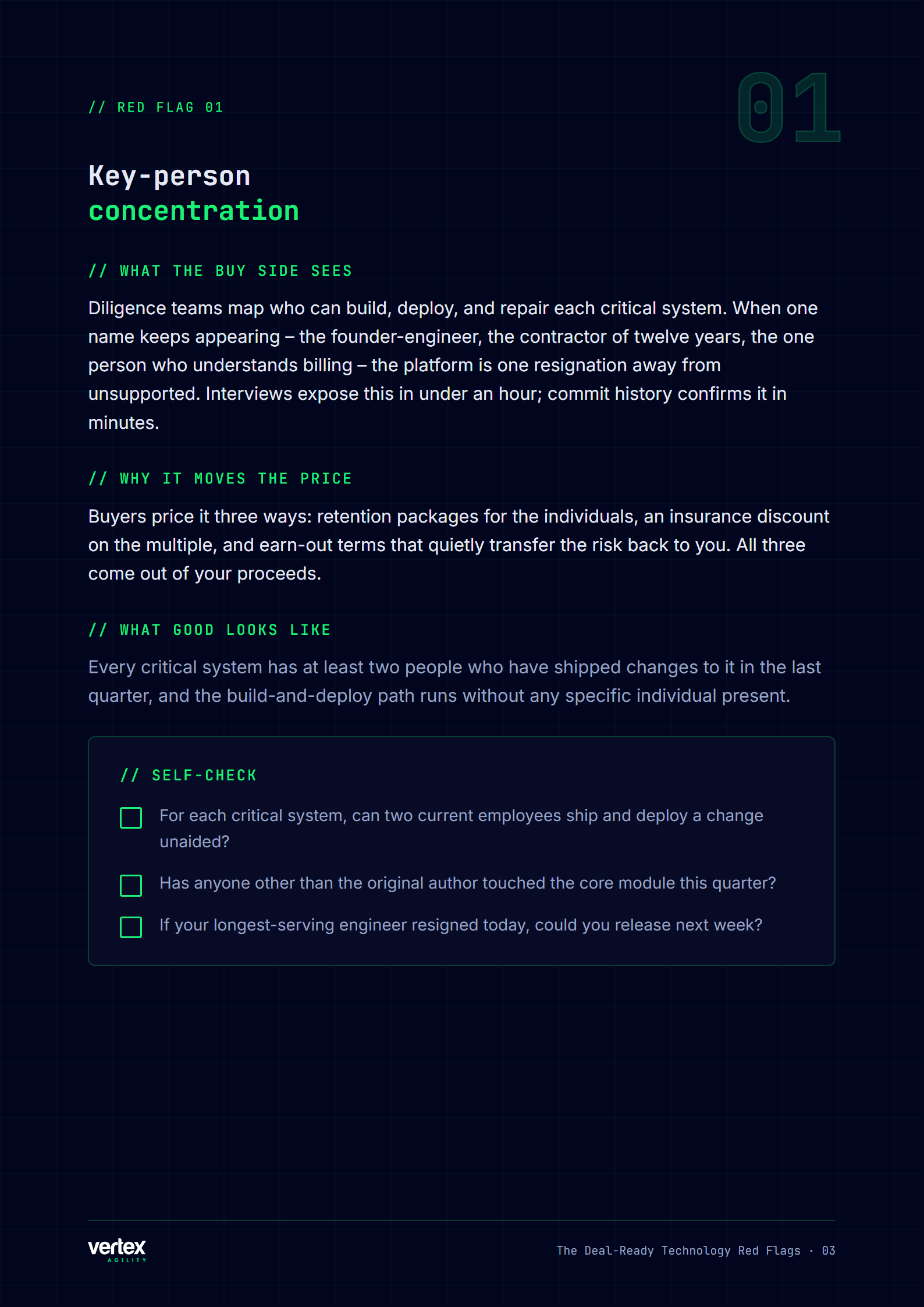
The platform is one resignation from unsupported – and buyers price that as retention packages, discounts, and earn-out terms.
The revenue-critical system exists as code plus memory. Slow to transfer, slow to integrate – both subtracted from the price.
The scan a buyer runs in week one: copyleft in the core, EOL components, and licences that die on change of control.
Deferred work nobody costed for the board – so the buyer's worst-case estimate becomes the only number in the room.
Ungoverned AI use is priced as risk; no AI story at all concedes the growth case to the buyer's plan instead of your multiple.
Quarterly releases and manual regression tell a buyer change is expensive here – and release capability is priced as growth capacity.
Not the absence of security – the absence of artefacts. Gaps convert into warranties, indemnities, and escrow holdbacks.
Deck metrics nobody can rebuild from source data. Deals rarely die of bad numbers – they die of unverifiable ones.
If the worksheet turns up a red, our Technology Due Diligence practice runs fixed-scope deal-readiness reviews – senior operators who have sat on both sides of the table, evidence in weeks. We won't pitch you – just a straight conversation about what a buyer would find.