

Gartner’s top strategic technology trends for 2027 read like a shopping list, and most organisations will treat them as one. Read them as an audit instead. Half the list is about what AI will do next. The other half is about whether you can control what it’s already doing, and each of those trends turns into a question your estate should be able to answer with evidence.
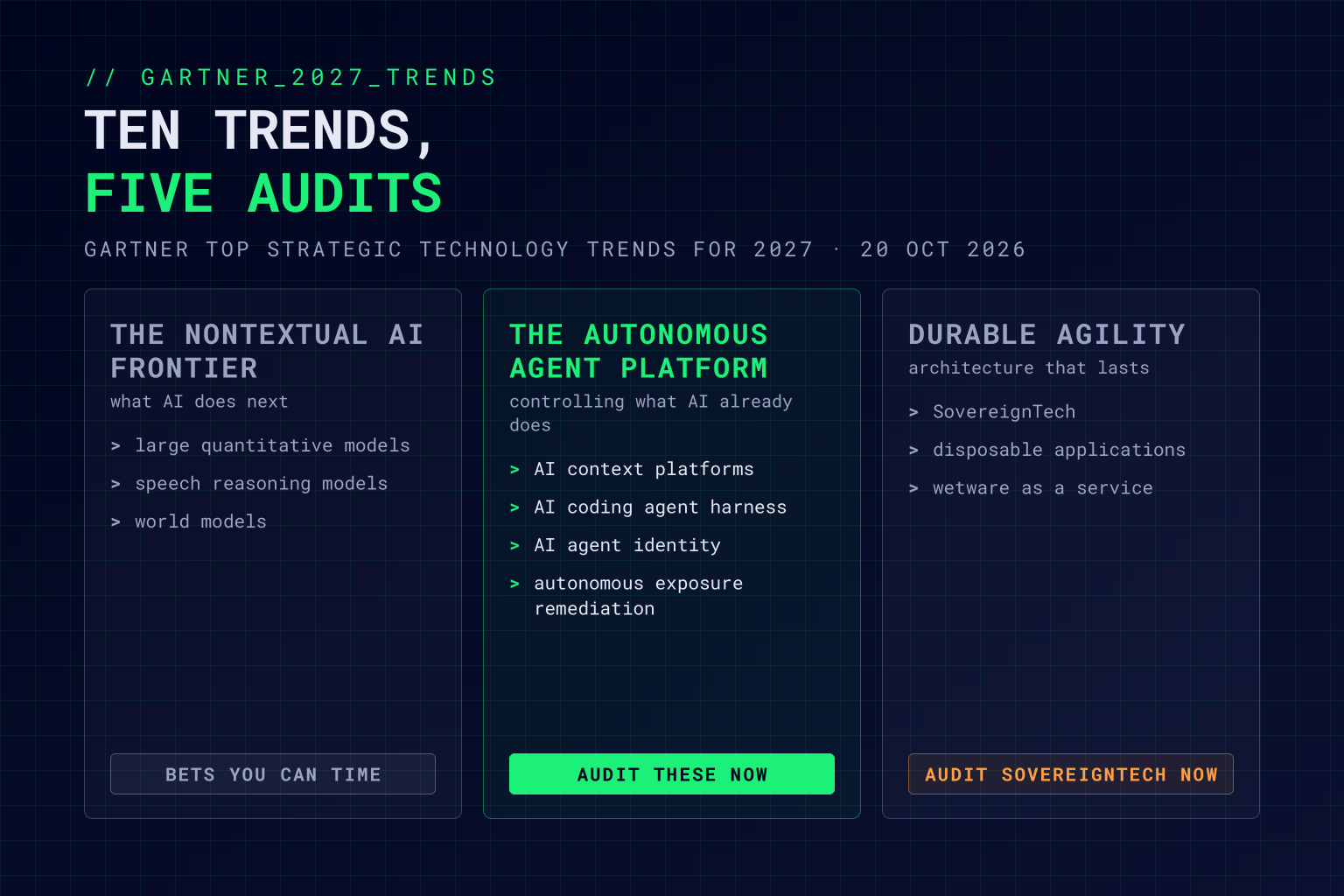
On 20 October, at its IT Symposium/Xpo in Orlando, Gartner published its top strategic technology trends for 2027. There are ten, in three groups. Three are about AI moving beyond text: large quantitative models, speech reasoning models and world models. Four sit under a heading Gartner calls “govern the autonomous agent platform”: AI context platforms, AI coding agent harnesses, AI agent identity and autonomous exposure remediation. The last three, under “architect durable agility”, are SovereignTech, disposable applications and wetware as a service.
Gene Alvarez, Distinguished VP Analyst at Gartner, summed up the problem behind the list: “The critical friction today is that AI systems operate in an architectural vacuum, generating software faster than humans can review it, creating unmanaged credential paths and binding processes to single-source vendor monopolies.”
That sentence names three failures, and every one is a control that’s missing, not a technology that hasn’t arrived. The frontier trends are bets you can time. The governance trends are audits you’re already late for.
Turn Each Trend Into One Question
A trend report tells you where the market is going. It doesn’t tell you where you stand. So take the five trends that describe controls, the four agent-platform trends plus SovereignTech, and turn each into the one question a CIO should be able to answer with evidence rather than intent. A policy document isn’t evidence. A register, a log or a measured number is.
AI Agent Identity: Can You Name Every Agent?
Gartner’s warning is blunt. Because AI agents “execute tasks independently and act on behalf of multiple humans, they expose massive vulnerabilities in legacy systems that cannot deliver just-in-time access.” It predicts that by 2028, “25% of enterprise security breaches will trace back to AI agent abuse, due to unmanaged machine privileges and legacy credential practices.”
The question: can you list every AI agent with access to your systems, who owns it, what it can reach, and when that access ends?
Most organisations can’t, because agents arrive the way shadow IT always did, on a borrowed token with no start date and no end date. We set out the fix in AI Agents Are Insiders Now: put agents through the same joiner, mover and leaver lifecycle you already run for people. Our identity governance case study shows what that lifecycle looks like when it’s automated, and why agents sharing credentials leaves you unable to tell which one was breached.
AI Coding Agent Harness: What Checks the Code Before It Ships?
Gartner describes an AI coding agent harness as “a closed-loop control system that governs autonomous developer behavior across the software development lifecycle.” Put simply, it’s the tests, policies, reviews and limits that sit around an AI coding agent, so its output is checked before it reaches production and its spend doesn’t run away.
The question: what share of your merged code do AI tools write, how much of it’s reworked within a month, and what does it cost per change that sticks?
Both halves of that question have already caught out large companies. Uber spent its AI budget in four months, driven by coding tools, and still couldn’t tie the spend to what it shipped. And when SpaceX bought Cursor, many engineering teams found their coding toolchain had a single owner they’d never chosen. As we argued in AI Is Writing More of Your Code Than Ever, the harness is usually the part that’s missing.
Autonomous Exposure Remediation: How Many Hours to Fix?
Gartner defines autonomous exposure remediation as “an integrated set of capabilities that combine AI techniques and automation to find, prioritize and fix security vulnerabilities across the enterprise digital estate.” It expects organisations that deploy it to cut their average vulnerability containment window “from weeks to within 48 hours” by 2031.
The question: when a critical flaw is disclosed in something internet-facing, how many hours does it take you to find every affected system and fix it, or take it offline?
Last month gave a live test. PHP2Shell was found with AI, exploited before the patch shipped, and fixed in releases most PHP servers were too old to install. Councils and government services took their websites offline rather than wait for a fix. Days later, the Budget funded AI to find flaws without saying who’d pay to fix them. Finding is getting cheap. Fixing is where the hours go.
AI Context Platforms: What Do Your Agents Know?
Gartner says AI context platforms “provide AI agents with the contextual knowledge they need to interpret inputs, make decisions, and act in line with business objectives”, and warns that without one, organisations face “overprivileged agents, compliance failures, low trust and excessive token consumption.” It predicts that by 2027, organisations that prioritise semantics in AI-ready data will increase agentic AI accuracy by up to 80% and reduce costs by up to 60%.
The question: when an agent acts, can you show which data and business rules it used, and that they were current and approved?
This is a data platform question before it’s an AI one. We’ve written about why the stack you built for analysts won’t work for agents, and where agents should live in your data and application platforms.
SovereignTech: What’s Your Exit?
Gartner defines sovereign tech as “hardware, software, databases and AI models technically and legally architected to offer realistic exit strategies from critical providers.” It predicts that by 2030, “over 75% of non-U.S. based organizations will adopt digital sovereignty strategies, shifting critical workloads to reduce geopolitical and vendor lock-in risks.”
The question: if a critical cloud provider or AI model were switched off for you tomorrow, which services would stop, and how long would it take to move them?
That isn’t hypothetical. In June, a government switched off a frontier model for every customer at once. In May, the European Commission proposed new cloud rules to keep sensitive public-sector data away from US hyperscalers, and the reasoning behind them applies to any regulated business. An exit strategy you’ve never rehearsed is a hope, not a strategy.
Score Your Estate
Give each question a colour. Be strict: if the evidence lives in someone’s head, it doesn’t count.
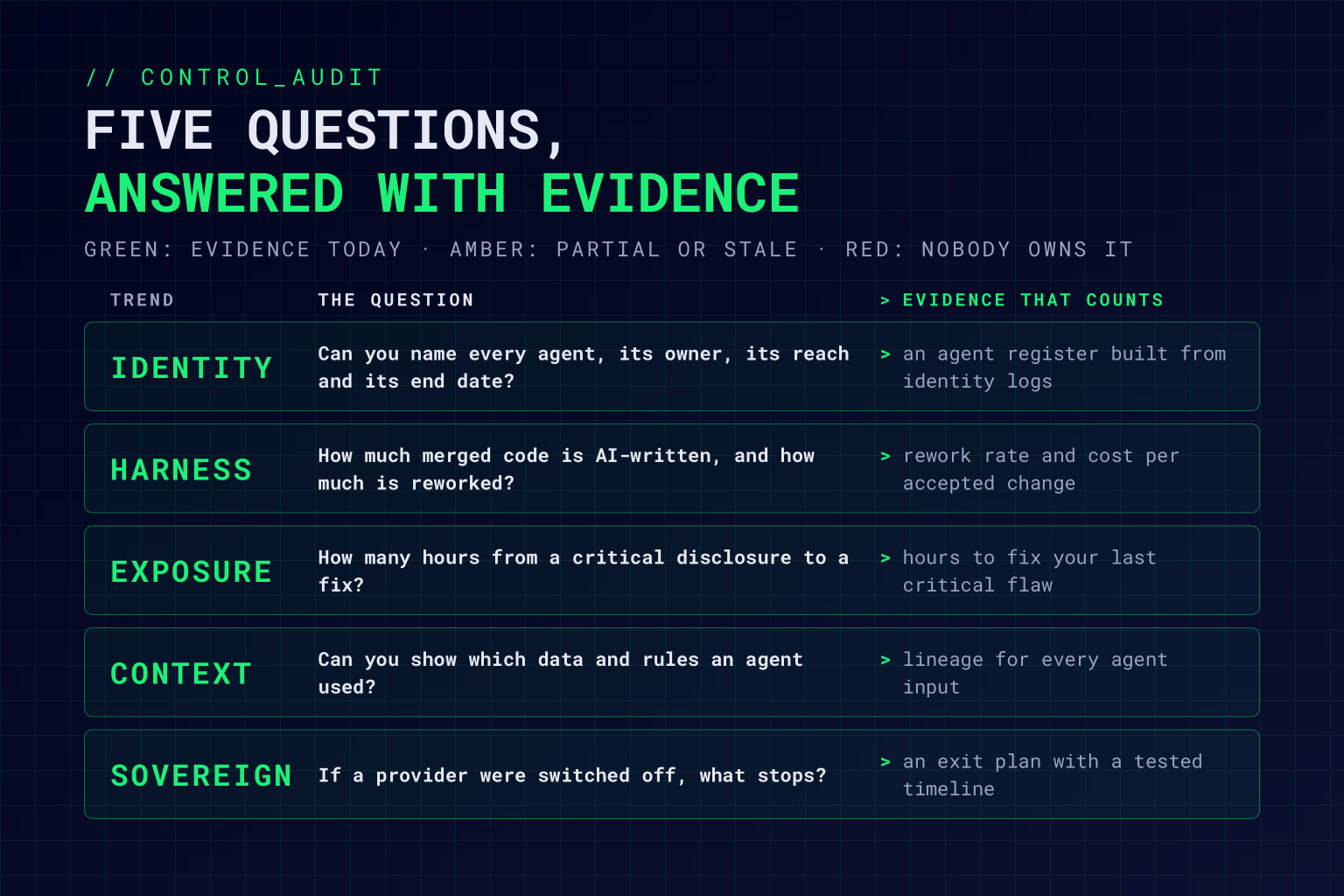
Green means you can produce the evidence today: the agent register, the rework rate, the hours-to-fix figure for your last critical flaw, the data lineage, the exit plan with a tested timeline. Amber means you know where the evidence should be but it’s partial, out of date, or held by one team. Red means nobody owns the question yet.
A red isn’t a failure, it’s a priority list. Start with the red that carries the most risk, which for most estates is agent identity or hours to fix, and make it amber this quarter.
The other five trends are still worth watching. Speech reasoning, world models and large quantitative models may matter a great deal to some sectors. But if you can’t answer the five questions above, any of them will land on an estate that can’t control it. Gartner’s own CIO survey, also released in October, found that only 13% of CIOs say their organisation has realised significant or transformational value from AI. Value tends to follow control, not the other way round.
Q&A: Gartner’s 2027 Strategic Technology Trends
What are Gartner’s top strategic technology trends for 2027?
Gartner named ten, in three groups. Large quantitative models, speech reasoning models and world models extend AI beyond text. AI context platforms, AI coding agent harnesses, AI agent identity and autonomous exposure remediation govern the autonomous agent platform. SovereignTech, disposable applications and wetware as a service architect durable agility.
Which of Gartner’s 2027 trends matter most for governance?
The four agent-platform trends and SovereignTech. Each describes a control: who an agent is and what it can reach, what checks AI-written code, how fast vulnerabilities are fixed, what context agents act on, and how you’d exit a critical provider.
What is AI agent identity?
It’s giving each AI agent its own governed identity, with an owner, access sized to its task and an end date, rather than letting it run on borrowed human credentials or shared keys. Gartner predicts that by 2028, 25% of enterprise security breaches will trace back to AI agent abuse.
What is autonomous exposure remediation?
It’s using AI and automation to find, prioritise and fix vulnerabilities across the whole estate, rather than relying on manual triage. Gartner expects it to cut average containment windows from weeks to within 48 hours by 2031.
How can we assess our readiness for these trends?
Turn each control trend into a question you must answer with evidence, such as an agent register or a measured hours-to-fix figure, and score it green, amber or red. A free benchmark such as a future readiness audit gives a quick read across software, cloud, data, security and AI before you go deeper.
Working Through This With Vertex Agility
As an AI-native transformation consultancy, we help organisations turn trend reports into controls that work. Our AI Consultancy practice puts AI where it pays back, with the governance to keep it honest. Our Security Healthcheck tests how quickly your estate can find and fix exposure, and Agentic DevOps puts specialist AI agents to work across your cloud estate behind policy and human approval.
If you’d like a quick read on where you stand, our free Future Readiness Audit benchmarks your software engineering, cloud, data, security and AI readiness in minutes. It’ll show you which of these questions your estate would struggle to answer first.