

This week’s Budget put tens of millions into AI that finds security flaws, a week after flaws found with AI took dozens of UK government services offline. Finding vulnerabilities is getting cheap and fast. Fixing them still moves at the speed of your oldest system, your slowest supplier, and your weekly change board.
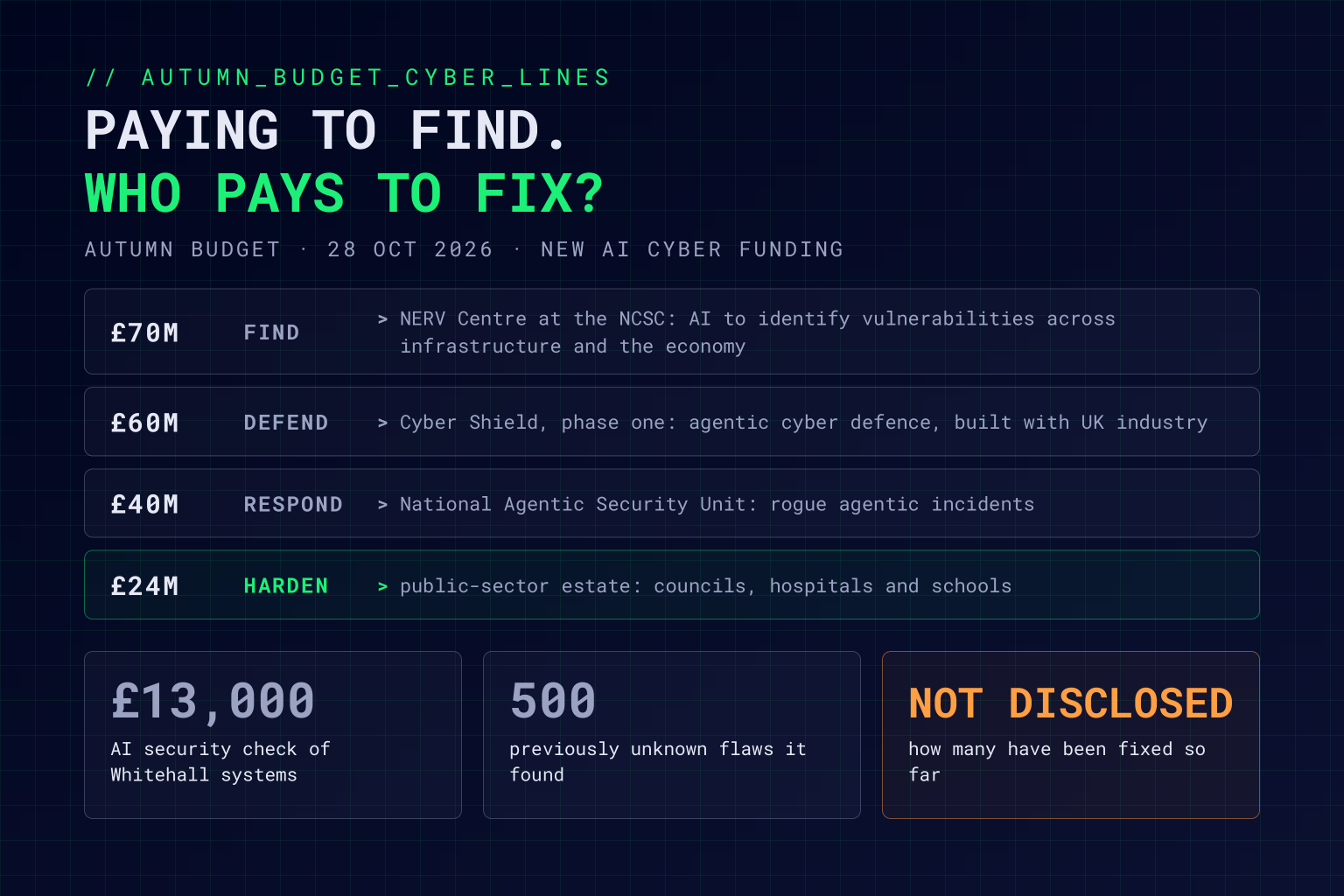
On Wednesday 28 October, the Autumn Budget committed £70m to a National Exposure and Real-Time Vulnerability (NERV) Centre inside the NCSC, which will “use artificial intelligence to identify vulnerabilities across critical infrastructure” and the wider economy. Alongside it sit £60m for “the first phase of a national Cyber Shield to develop agentic cyber defence capabilities”, £40m for a National Agentic Security Unit “to investigate and respond to rogue agentic incidents”, and £24m to “systematically harden the public sector technology estate”.
The timing wasn’t subtle. Five days earlier, the AI minister Kanishka Narayan told the BBC’s Political Thinking podcast that a frontier-model security check of Whitehall systems had turned up 500 previously unknown vulnerabilities. “We only spent £13,000 on it,” he said. That same week, PHP2Shell, a pair of critical flaws found with AI, left 32 government services unavailable, mostly as a precaution.
Finding vulnerabilities just got cheap. Fixing them didn’t. That’s the gap the Budget doesn’t close, and for most organisations it’s where the real exposure now sits.
£26 a Flaw Is the Easy Part
£13,000 for 500 previously unknown flaws works out at £26 each. What happens next hasn’t been published. The minister didn’t say what the flaws were, and there’s been no word on how many have been fixed. That isn’t a criticism of Whitehall. It’s the honest shape of the problem everywhere. Each finding still needs someone to confirm it’s real, work out which system it’s in and who owns that system, build and test a fix, get the change approved, deploy it, and check it’s actually running.
PHP2Shell showed both halves in a single week. The flaws were found with AI, and fixed versions shipped on 21 October. But Bitsight found that only about a third of PHP instances with a visible version ran a branch that got the fix, and attackers had started probing four days before the patch existed. For the rest, as we covered in PHP2Shell Was Found With AI, the fix was an upgrade project, not a patch.
AI has moved the bottleneck in security from finding flaws to fixing them. Every organisation that runs an AI-assisted review, or gets a warning from a national scanner, is about to find out how long its fix queue really is.
What the Budget Pays For, and What It Can’t
Most of the new cyber money goes on seeing exposure faster. NERV is there to “strengthen the UK’s ability to understand and reduce national cyber exposure”. The Cyber Shield is described as using agentic AI to “discover and fix cybersecurity weaknesses” across government networks and critical national infrastructure. The £24m programme to harden the public-sector estate is the line closest to fixing, and it’s spread across local authorities, hospitals, and schools. The Budget doesn’t say how NERV will differ from the NCSC’s existing early-warning services, and the NCSC declined to comment when The Record asked.
For everyone outside government, the picture is simpler. A national centre can tell you you’re exposed. It can’t upgrade your estate, rewrite your supplier contracts, or test your legacy application. As Logicalis’s James Gillies put it after the Budget, “national defences can’t fix what businesses can’t see inside their own walls.”
The Budget also hinted at who’ll carry the cost. The government “will consult next year on how to tackle insecure technology at source” and will “consider where liability for cyber breaches should sit”. That builds on the Law Commission’s review of product liability, open until 14 January, which proposes treating software and AI systems as “products” under the Consumer Protection Act 1987. If liability moves towards the people who ship and run software, the time it takes you to fix a known flaw stops being an internal metric and starts to look like evidence.
Why Fixing Is Slow, and It Isn’t Laziness
When a critical fix takes weeks instead of hours, the cause is rarely a lack of skill. It’s structural, and the same five reasons come up again and again.
Nobody’s sure who owns it. The finding lands on a system that belongs to a team that’s since been reorganised, or an application nobody’s touched since the contractor left. Triage stalls while someone works out who can make the call.
The fix needs a version you’re not on. Patches ship for supported releases. If the system runs an end-of-life runtime, framework, or operating system, the fix is an upgrade project, and upgrade projects get scheduled, not shipped.
Nobody trusts the change. Without automated tests around what the system does today, every change is a gamble. So teams batch changes, delay them, and test by hand.
The process is built for planned work. A weekly change board and a manual release are fine for features. For a flaw that’s being exploited within hours of disclosure, they’re the slowest part of the chain.
The patch sits with someone else. Hosting providers, agencies, and SaaS vendors all have their own queues. As last week’s precautionary shutdowns showed, your restore date is often whatever your supplier says it is.
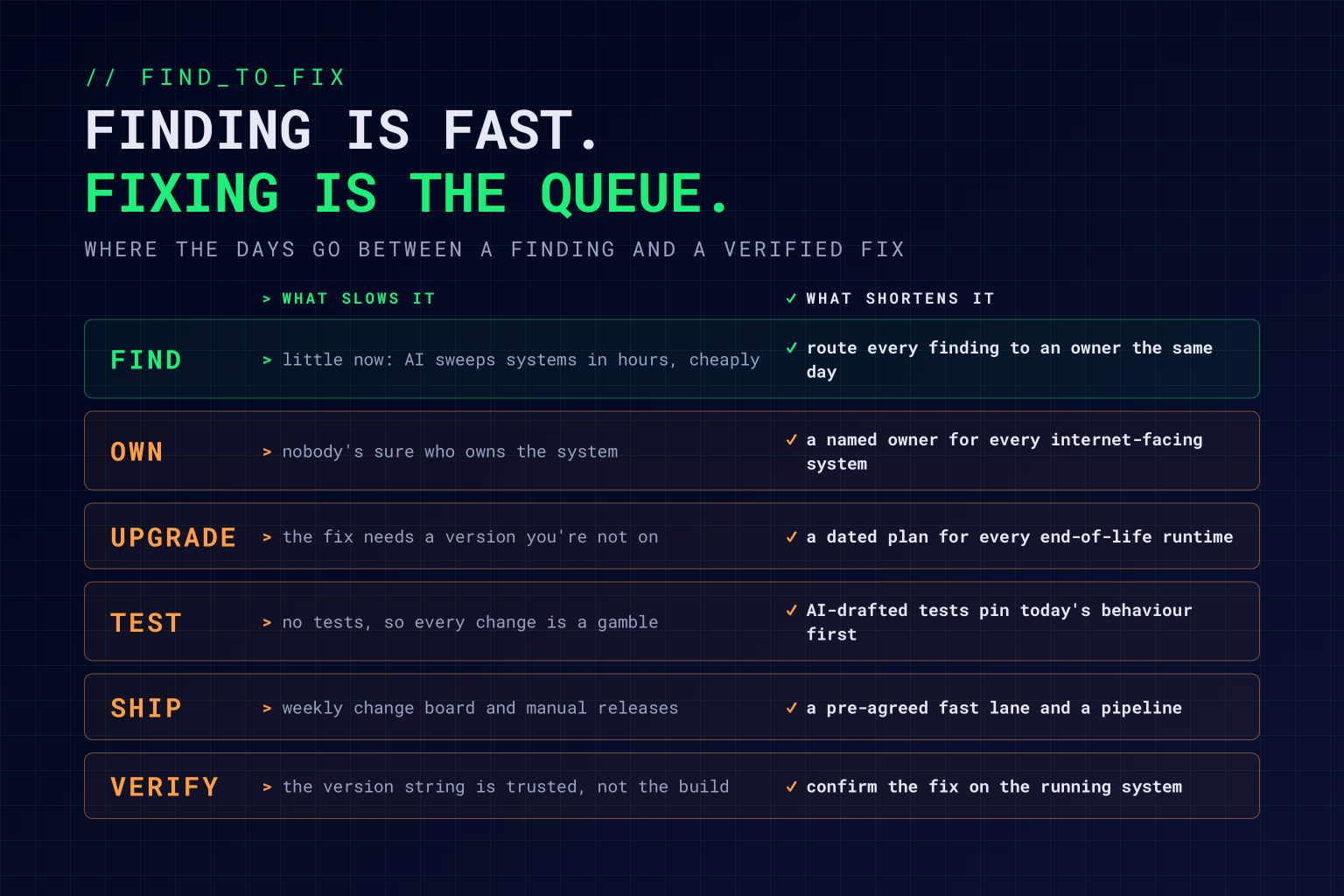
If a critical fix needs a project rather than a pipeline run, your time to fix is measured in weeks, whatever your scanner costs.
Put AI on the Fixing Side Too
The capability that makes discovery cheap can make remediation faster too, as long as people stay in charge of what ships.
Map. AI matches each finding to the system, the runtime, and the owner, so triage starts the same day rather than the following week.
Pin. AI writes characterisation tests that capture what a legacy system does today, before anyone changes it, so the fix can be checked rather than hoped for.
Draft. AI drafts the fix or the upgrade as small, reviewable changes and runs the regression suite against each one.
Decide. Engineers approve or reject every change, own the release, and confirm the fix on the running system.
It’s the same pattern we set out for Agentic DevOps: agents do the legwork, while policy and people set the guardrails. If attackers and auditors are both using AI to find flaws, a remediation process that runs at human speed alone will fall behind.
Where to Start This Month
Measure time to fix, not number of findings. Track the days from a critical finding to a verified fix on internet-facing systems. A findings report that grows every month is a sign the fix side can’t keep up.
Give every internet-facing system an owner and a supported runtime. List anything on an end-of-life runtime and put a date on it: upgrade it, buy extended support, or retire it.
Build a fast lane for critical fixes. Agree an emergency change route in advance, backed by automated tests and a deployment pipeline that can ship a fix in hours.
Put fix times in supplier contracts. For anything you don’t patch yourself, get a response commitment for critical vulnerabilities, in hours, in writing.
Run AI on your own estate before someone else does. Pick one important system, run an AI-assisted review, and follow every finding through to a verified fix. The number that matters isn’t how many flaws you found. It’s how many you closed, and how long it took.
Q&A: The Budget, AI and Fixing Vulnerabilities
What did the Autumn Budget 2026 announce for cyber security?
The 28 October Budget committed £70m to a National Exposure and Real-Time Vulnerability (NERV) Centre at the NCSC, £60m for the first phase of a national Cyber Shield built on agentic AI, £40m for a National Agentic Security Unit to respond to rogue AI agent incidents, and £24m to harden the public-sector technology estate. It also said the government will consult next year on insecure technology and on where liability for cyber breaches should sit.
What is the NERV Centre?
A new centre within the National Cyber Security Centre, funded with £70m, that will use AI to identify vulnerabilities across critical infrastructure and the wider economy. The Budget didn’t say how it’ll differ from the NCSC’s existing early-warning services.
What did the government’s £13,000 AI security check find?
The AI minister Kanishka Narayan told the BBC that a frontier-model security check of Whitehall systems, costing £13,000, found 500 previously unknown vulnerabilities. He didn’t say what they were, and there’s been no word on how many have been fixed.
Will software companies become liable for cyber breaches in the UK?
Not yet. The Budget said the government will consult next year on tackling insecure technology at source and on where liability for cyber breaches should sit. Separately, the Law Commission is consulting until 14 January on treating software and AI systems as products under the Consumer Protection Act 1987.
How can AI help fix vulnerabilities, not just find them?
AI can match findings to systems and owners, write tests that capture how a legacy system behaves today, and draft fixes or upgrades as small changes that run through your regression suite. Engineers still approve every change and confirm the fix on the running system.
Working Through This With Vertex Agility
As an AI-native transformation consultancy, we help organisations close the gap between finding flaws and fixing them. Our Security Healthcheck gives you a fast read on where your exposure sits. Modern App Discovery shows you what you’re running, where the technical debt is, and what it’ll take to upgrade, and our Legacy Modernisation Strategy turns end-of-life systems into a funded, dated plan. An AI Proof Sprint can put a governed AI agent to work on one well-bounded part of remediation, with your engineers deciding what ships.
If you’d like a quick read on where you stand, our free Future Readiness Audit scores your software engineering, security posture and AI readiness side by side. It takes minutes, and it’ll show you whether your fixing can keep up with your finding.