

When the AI coding tool your engineers depend on is bought by a frontier-model competitor, the question stops being what it does and becomes who controls it now.
On 16 June, SpaceX agreed to buy Anysphere, the company behind the AI coding assistant Cursor, in an all-stock deal valued at $60 billion. It is the largest acquisition of a venture-backed startup on record, and it will fold Cursor into the same group as xAI, the maker of Grok, which SpaceX merged with earlier this year. The deal is expected to close in the third quarter of 2026, subject to regulatory approval.
The headline is the price. The part that matters for everyone running an engineering team is quieter. Cursor built its enterprise following on being neutral across models and clouds, and neutrality is exactly what this deal removes.
The Deal, and Why It’s Different
Cursor is not a fringe tool. It reached roughly $4 billion in annualised revenue in under four years, about $2.6 billion of that from enterprise customers, with more than 50,000 enterprise clients and developers at around two-thirds of the Fortune 500 using it. By one account it generates close to 150 million lines of enterprise code a day. That is a lot of organisations with a lot of source code running through one product.
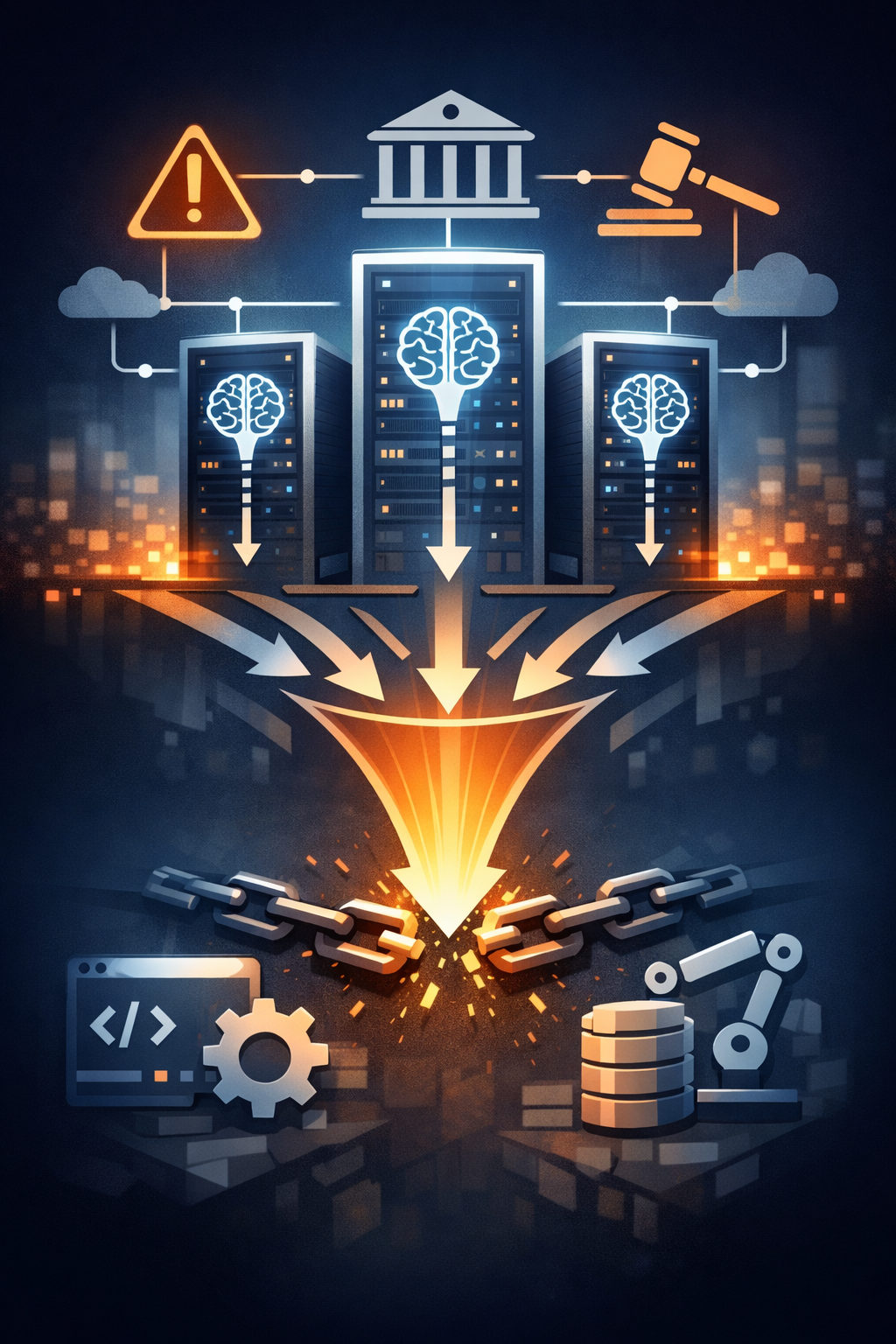
Here is the awkward bit. Cursor reached that scale while leaning on Anthropic’s and OpenAI’s models to do the actual reasoning. It sat on top of the frontier labs as a neutral layer, and enterprises liked it precisely because it let them pick the best model for the job. SpaceX, through xAI and Grok, now competes directly with those same labs. An independent tool has moved inside a model maker’s stack, and a layer that used to be model-agnostic is becoming captive to one owner.
Mitch Ashley of The Futurum Group put the consequence plainly: enterprise buyers now have to re-underwrite Cursor as a single-owner dependency, and the question shifts from what the tool does to whether a newly public conglomerate with no enterprise software track record will look after a developer layer whose model partners it now competes against. That is the right question, and most teams have never had to ask it about their coding tool before.
What Enterprises Actually Signed Up For
When a business standardised on Cursor, it was buying more than autocomplete. It was buying a position: a tool that would route to whichever model performed best, that wasn’t tied to a single lab’s commercial interests, and that treated the customer’s code as the customer’s business. The Ramp corporate-spending data tells you how fragile that position turned out to be. Cursor’s share of the AI coding market fell from around 41% in June 2025 to roughly 26% by May 2026, while Anthropic’s own coding tools climbed toward half the category. Part of the reason was a margin trap: Cursor paid retail model pricing while the labs ran wholesale economics on their own competing products.
So the company that sold neutrality was being squeezed by the very labs it depended on, and it sold to a third lab that wanted in. The strategic logic for SpaceX is clear. The strategic comfort for an enterprise customer is not.

The Data Question You Now Have to Re-Ask
This is where engineering leaders should slow down. According to reporting on the deal, SpaceX has said Cursor’s coding data will feed Grok’s training pipeline, and a jointly developed model is already in training on xAI’s Colossus supercluster, destined for both Cursor and a new product called Grok Build.
For a business, the asset at risk is the code itself, and the patterns in how your engineers work. If you run Cursor on an enterprise tier with privacy protections or zero data retention, those terms may still hold. The point is that they were agreed with a company that is about to stop existing as an independent entity. Assurances about data use are only as durable as the ownership behind them, and the ownership is changing. The honest position is not to assume your code is now training a rival model, and not to assume it isn’t. It is to re-read the contract before the deal closes, confirm in writing what survives the change of control, and understand exactly what feeds training and what does not.
This Isn’t Really About Cursor
Step back and the specific tool matters less than the pattern. The model layer is consolidating at speed, with several frontier-class models launching inside a single month and at least one pulled from customers overnight by government order. The independent, model-neutral layers that sat above all that are being acquired one by one. Any single-vendor dependency in your engineering toolchain is now a risk worth pricing, not a convenience worth defending.
None of this means ripping Cursor out. It is a capable tool, and a reactive migration driven by a headline is its own kind of mistake. What it means is that the resilience of your toolchain is an architecture decision, and most teams have been treating it as a purchasing one. The teams that come through this calmly are the ones whose AI tooling sits inside a pipeline they control, swappable without a rewrite, rather than wired so deeply into daily work that changing it would stop the business.
What to Sort Out Before the Deal Closes
If your developers run Cursor, a short list is worth working through this quarter, while you still have leverage and time:
- Re-read the data and IP terms. Confirm in writing what happens to your code and usage data on a change of control, and whether any training exclusion or retention guarantee survives.
- Know your switching cost. Map how locked in you really are: custom rules, configurations, workflows, and the muscle memory of every developer who uses it daily. The number is usually higher than people expect.
- Keep the AI layer swappable. Treat the coding assistant as a component, not a foundation. If moving to another tool would take months, that is a design problem to fix now.
- Govern what leaves your estate. Static analysis, dependency scanning, and secrets detection should sit in your own pipeline, catching exposure before code ever reaches a third-party tool.
- Keep the architecture with your engineers. The decisions that matter should live with your people and your records, not inside a vendor’s product that can be sold over a weekend.
Q&A: Re-Underwriting Your AI Coding Tool
Should we drop Cursor and move to something else?
Not on reflex. Cursor is still a strong tool, and a panic migration carries its own cost and disruption. The right response is to re-evaluate it as a single-owner dependency rather than a neutral layer, confirm the data terms, and make sure you could move if you needed to. Keep your options open; don’t necessarily exercise them.
Is our source code now training Grok?
The honest answer is that it depends on your tier and contract, and the reporting says coding data is slated to feed Grok’s training. If you’re on an enterprise plan with privacy protections, those may still apply, but they were agreed with a company that is changing hands. Get written confirmation of what survives the change of control before the deal closes in Q3.
We’re locked into Cursor across the whole team. How exposed are we?
That depends entirely on how deeply the tool is wired into your daily workflow and how much custom configuration sits on top of it. The exercise is to measure the switching cost honestly. If replacing the assistant would take months and stall delivery, that dependency is an architecture issue worth addressing regardless of who owns the vendor.
Isn’t this just normal industry consolidation we should ignore?
Consolidation is normal. Ignoring its effect on your risk profile is not. The specific change here is that a neutral layer your engineers depend on is now owned by a competitor to the model providers it was built to keep you free to choose between. That changes the dependency, even if the product keeps working exactly as it did yesterday.
How do we stop this happening with the next tool?
Design for it. Treat every AI tool in your pipeline as a swappable component, keep architectural decisions and code governance inside your own estate, and avoid wiring any single vendor so deeply that leaving it would halt delivery. The goal is a toolchain where a vendor being acquired is an inconvenience, not a crisis.
Working Through This With Vertex Agility
The lesson underneath this deal – that the resilience of your engineering toolchain is an architecture decision, not a purchasing one – is the principle our Software Consultancy practice is built on. Our position is simple: engineering without architectural governance is expensive rework, and that applies to the tools in your pipeline as much as the code they produce.
Our AI-Augmented Engineering Pipelines capability puts AI to work across code generation, review, test creation, and refactoring, sitting inside your own CI/CD rather than locking you to a single external product. Senior engineers govern every architectural decision; the AI handles the repetitive work. That is the difference between AI as augmentation you control and AI as a dependency that controls you. Alongside it, our Security & Performance work builds OWASP-grade controls, AI-assisted static analysis, and dependency scanning into the pipeline from the start, so you know what leaves your estate before it leaves.
Because we deliver against a technical roadmap built for your outcome, and we keep tooling swappable by design, a vendor being acquired becomes a decision you make calmly rather than a fire you fight. As a senior-led partner working across Microsoft, AWS, Google, and Salesforce, we help engineering leaders modernise without betting the business on any single supplier.
If you want a clear-eyed view of how resilient and well-governed your engineering pipeline actually is, our free Platform Engineering Maturity Assessment is a good place to start. For a direct conversation about reducing toolchain and vendor risk in your delivery, get in touch with us below.