
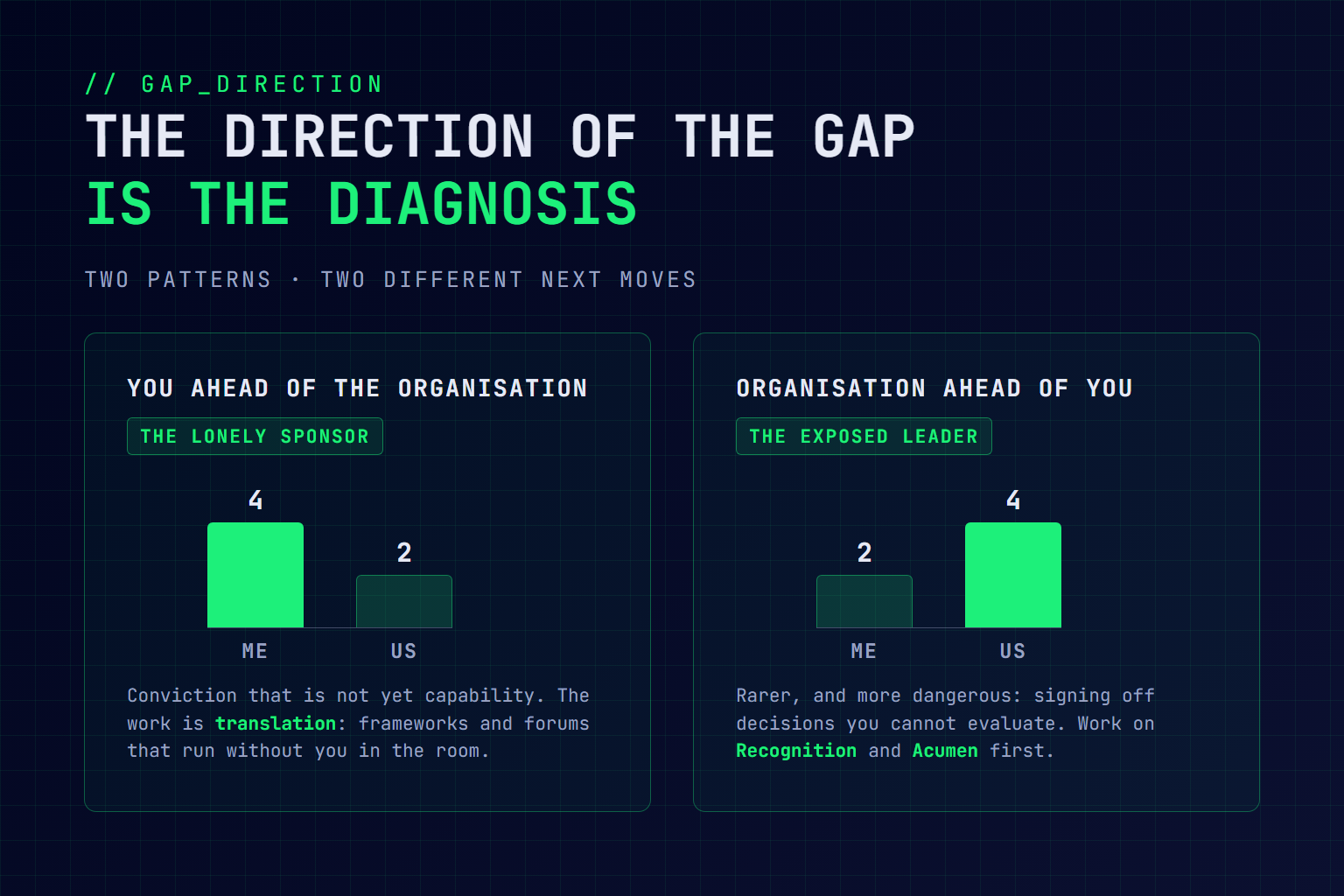
Every statement in the AI Leadership Readiness Scorecard is asked twice: once about you, once about your organisation. Leaders fixate on the two scores. The finding is the distance between them.
Series – this is part 2 of 2 on AI leadership readiness. Part 1: The AI Readiness Assessment Nobody Runs.
Ask a leader to rate their own AI readiness and you get one kind of information. Ask them to rate their organisation’s readiness on the same statement, in the same breath, and you get something better: a calibration. The two answers check each other.
The scorecard does this 40 times. Here are three of those pairs. Score yourself honestly, 1 to 5, before reading on – you will get more out of the rest of this article.
Try Three of Them Now
From Strategic Vision & AI Literacy:
Me: “When a new AI capability emerges in my industry, my first instinct is to ask what it means for our competitive position – not which tool to adopt.”
Us: “My organisation has a clearly articulated view of where AI creates strategic value for us – and where it does not.”
From Ethics, Risk & Governance:
Me: “I can distinguish between AI risks I should personally own as a leader and those I can appropriately delegate to legal, technology, or compliance functions.”
Us: “My organisation has a clear framework for AI risk and ethics that senior leaders are expected to understand and apply – not just sign off.”
From Execution & Value Realisation:
Me: “Before engaging with any AI solution, I ask what specific problem it solves and what evidence exists that it solves that problem well.”
Us: “My organisation evaluates AI initiatives primarily on the business problem they solve – not the sophistication of the technology.”
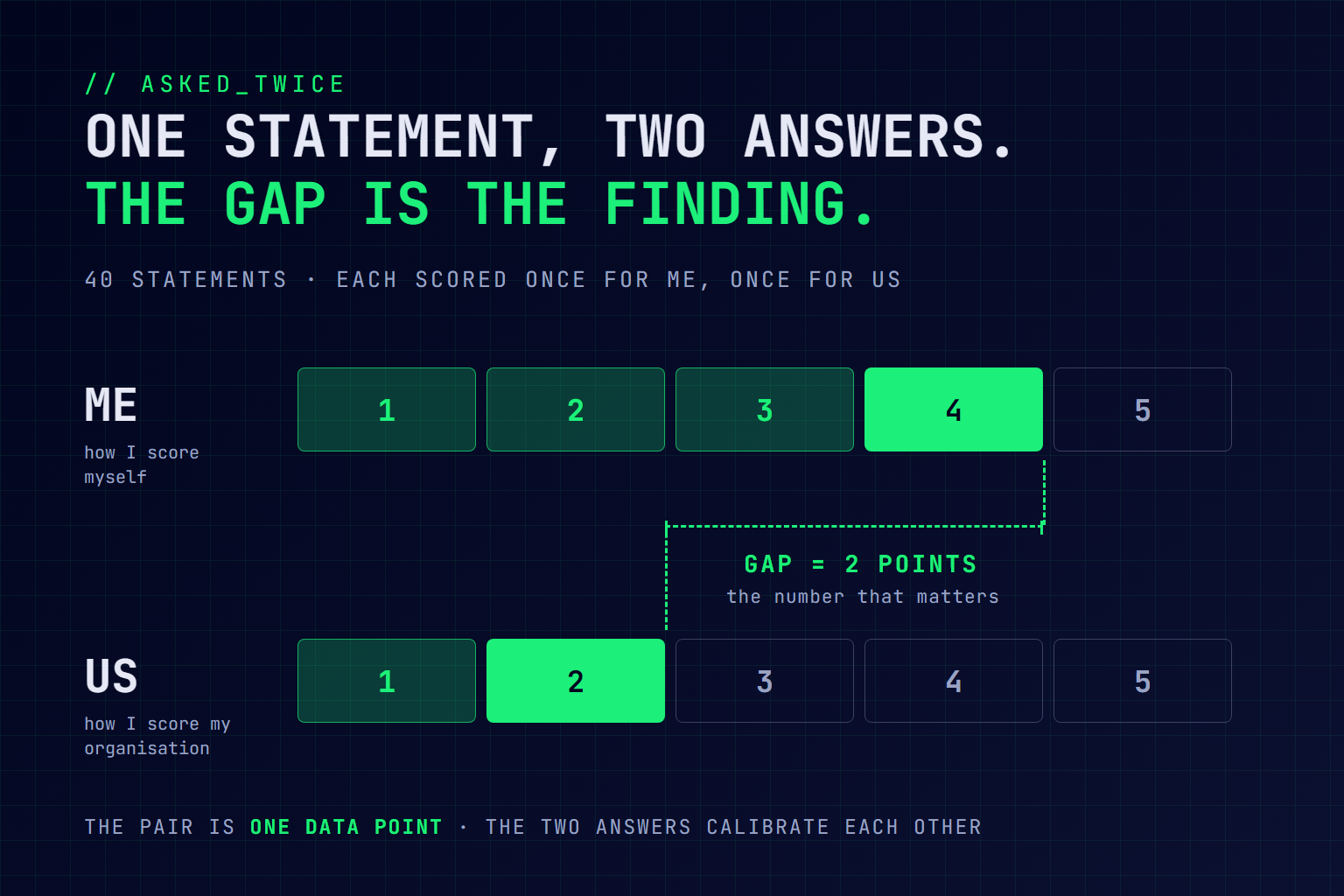
If your two numbers matched on all three, you are unusual. Most people find a gap, and the direction of that gap is diagnostic.
When You Are Ahead of Your Organisation
You scored yourself 4s and the organisation 2s. This is the lonely-sponsor pattern, and it is the more common gap. Your personal conviction about AI has not yet become anything your organisation can use: there is no articulated view of where AI creates value, no risk framework leaders actually apply, no discipline about which problems get an AI solution.
A leader who is two points ahead of their organisation does not need more personal learning. They need to spend their readiness building the organisation’s.
Left alone, this gap produces a familiar graveyard: pilots that impressed everyone and changed nothing, because the sponsor’s judgement never turned into shared infrastructure. The work is translation – turning what you know into frameworks, expectations, and forums other people can operate without you in the room.
When Your Organisation Is Ahead of You
The reverse gap is rarer and more dangerous. The governance framework exists, the data teams are moving, delivery is underway – and the leader is signing off decisions they do not really understand. RAND’s research into failed AI projects found the leading cause was leaders misspecifying the problem the technology was meant to solve, which is precisely what delegated judgement looks like at the top of a programme.
An organisation can outrun its leadership for a while, but every significant decision eventually queues behind the least-ready person with the most authority.
If your “us” scores beat your “me” scores, the scorecard will usually name Recognition or Acumen as your constraint. That is not an insult. It is a reading list.
Why We Ask Everything Twice
Self-report inflates. Everyone rating only themselves drifts upward, which is why the scorecard asks the same construct from two angles and treats the pair as one data point. A leader who rates themselves 5 and their organisation 2 on every statement is telling us something quite different from a leader who rates both a 3 – even though their “me” averages differ wildly.
It is also why one REACH stage, Competency, is never self-scored at all. Demonstrated ability is evaluated through coaching, because no honest instrument lets you grade your own practice. An assessment that admits the limits of self-assessment is one you can take seriously.
Q&A: Reading Your Me/Us Gap
Why does the scorecard ask each question twice?
Because the pair of answers calibrates each other. Your self-rating alone is inflated by ordinary self-report bias; rating your organisation on the same statement anchors it, and the gap between the two is itself a finding.
What does it mean if I score higher than my organisation?
You are a sponsor whose conviction has not yet become organisational capability. The priority is translation: articulated strategy, applied risk frameworks, and problem-first evaluation that work without you in the room.
What does it mean if my organisation scores higher than I do?
Your teams are moving faster than your judgement can supervise, which is how leaders end up approving what they cannot evaluate. Recognition and Acumen are usually the stages to work on first.
Is a small gap always good?
No – two matched low scores mean you are aligned and unready. The gap tells you where the work is; the absolute scores tell you how much of it there is.
The series began with part 1, The AI Readiness Assessment Nobody Runs – the case for assessing the leader, and how the REACH scorecard does it.
Working Through This With Vertex Agility
The me/us gap is where most of our leadership conversations start, because it hands a leader their actual next move rather than a generic maturity grade. If your gap points at organisational translation, or at your own Acumen, our AI consultancy practice works on exactly that, diagnostic-first.
Find your gap with the AI Leadership Readiness Scorecard – 40 statements, each asked twice, about 15 minutes, free.