

Your data estate has been audited. Your cloud has a roadmap. Procurement has been through every AI vendor twice. The one variable still unexamined is the person chairing the steering committee.
Series – this is part 1 of 2 on AI leadership readiness. Part 2: The Most Useful Number in AI Readiness Is a Gap.
By mid-2025, 42% of companies had scrapped the majority of their AI initiatives, up from 17% a year earlier, according to S&P Global Market Intelligence. RAND puts the failure rate of AI projects above 80%, roughly double the rate of comparable IT projects. Faced with numbers like these, most boards respond the same way: commission another readiness assessment.
So the data gets audited again. The architecture gets reviewed again. The subject is almost always the organisation. Almost never the person running it.
The Uncomfortable Direction the Evidence Points
When RAND interviewed data scientists about why AI projects fail, the leading cause was not the models. It was leaders misunderstanding, or miscommunicating, the problem the AI was meant to solve. BCG reached a similar conclusion from the other direction: in its analysis of AI programmes at scale, roughly 70% of the difficulty sat with people and process, 20% with technology, and 10% with the algorithms themselves.
The most expensive component in a failing AI programme is usually the judgement at the top of it, and it is the only component nobody has measured.
That should sting a little. It is also fixable, because leadership readiness turns out to be assessable in the same way delivery readiness is – provided you measure the right things.
What AI Actually Asks of a Leader
The AI Leadership Readiness Scorecard is built on the REACH framework, which treats AI leadership as a progression through five stages. Recognition: understanding what AI does and does not change for your role and your organisation. Engagement: the personal will to sponsor it visibly rather than approve it quietly. Acumen: the informed judgement to weigh use cases, governance, and trade-offs without delegating every decision by default. Competency: demonstrated ability in practice. Habit: the practices sustained until they are routine rather than a burst of enthusiasm after a conference.
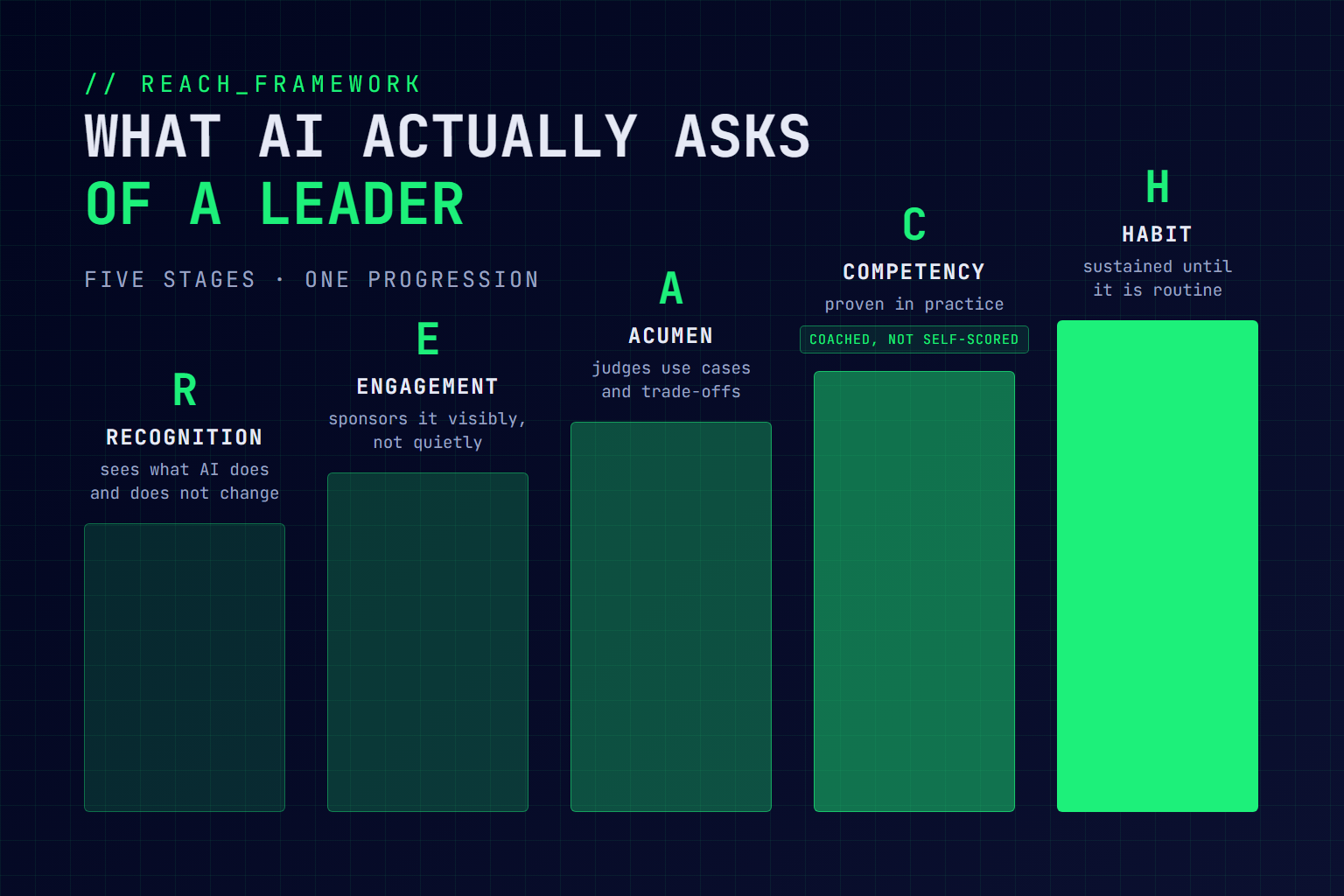
One design decision is worth pausing on. Competency is never self-scored. Demonstrated ability cannot be established by asking someone to rate themselves, so the scorecard does not pretend otherwise – it is developed and evaluated through coaching, not self-report.
Your Weakest Stage Sets Your Ceiling
Averages flatter. A leader who scores well on Recognition and Acumen but poorly on Habit does not receive a respectable overall grade from this model. They get told, plainly, that Habit is their primary constraint, because that is how it plays out in a business: the strategy deck is excellent, and the sponsorship has evaporated by the third steering meeting.
Capability that shows up in bursts is indistinguishable, to the organisation watching, from no capability at all.
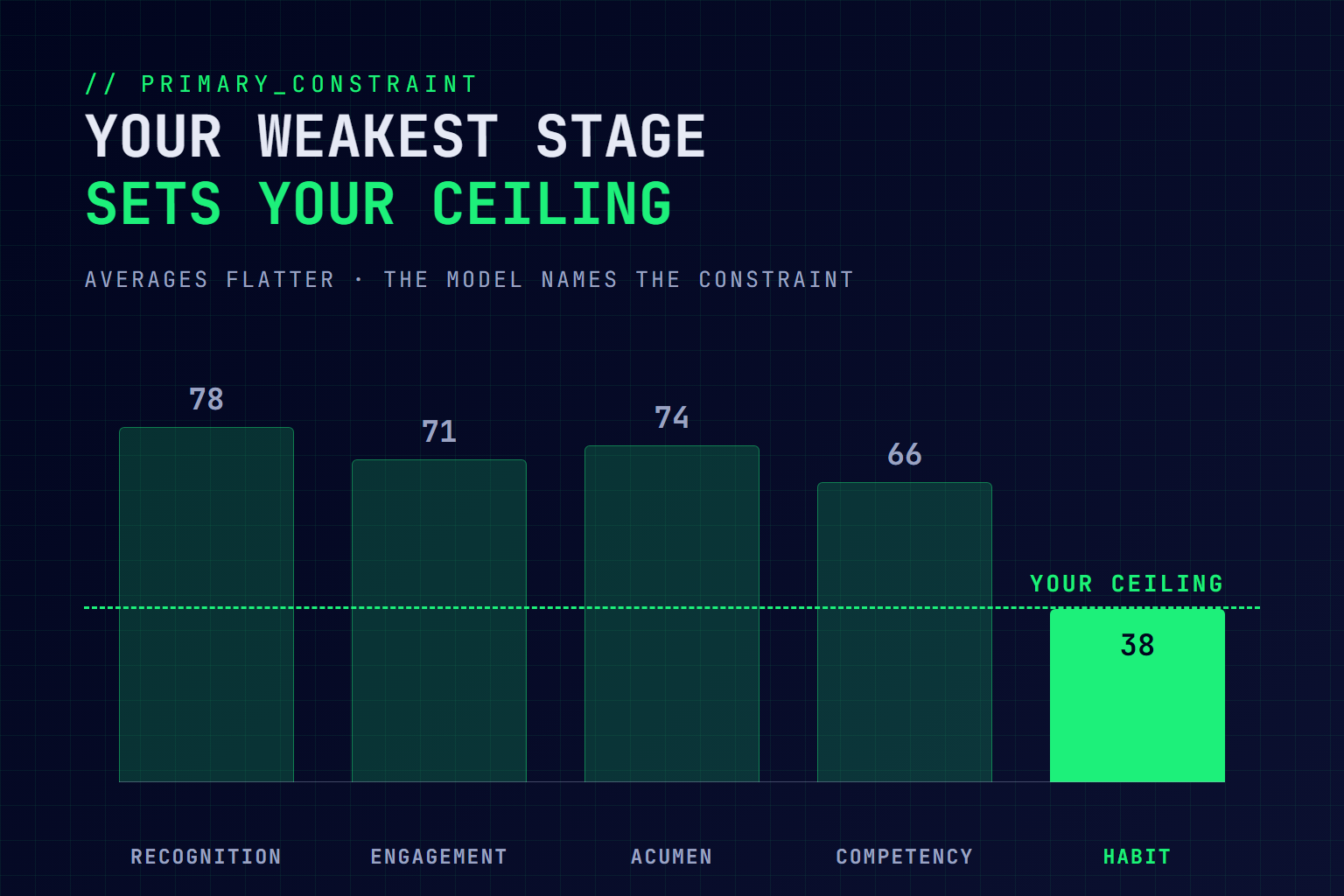
This is the part organisational assessments cannot see. A data maturity audit will never tell you that the programme’s real bottleneck is that its sponsor stopped turning up.
Fifteen Minutes, Honestly Spent
The scorecard itself is 40 statements across five areas: strategic vision and AI literacy; ethics, risk and governance; organisational and cultural change; data and technological foundations; and execution and value realisation. Each statement is scored twice – once about you, once about your organisation. The gap between those two numbers deserves an article of its own, and it gets one next in this series.
It takes about 15 minutes. It is free. The result is a personal REACH profile with your strengths, your focus areas, and one named primary constraint to work on first, rather than a vague exhortation to “build AI capability”.
Q&A: The AI Leadership Readiness Scorecard
What is the AI Leadership Readiness Scorecard?
A free self-assessment of 40 statements that measures a leader’s personal readiness to lead in an AI-enabled environment, mapped across the five REACH stages. It takes about 15 minutes and returns a profile with strengths, focus areas, and a named primary constraint.
Who should take it?
CEOs, CTOs, CFOs, COOs, directors, and board advisors – anyone accountable for AI outcomes rather than for the build itself. It is most useful before commissioning strategy or transformation work, when knowing your own constraint changes what you ask for.
How is it different from an organisational AI readiness assessment?
Organisational assessments measure data, infrastructure, and process maturity. This one measures the leader, and asks every question about the organisation as well, so the gap between the two becomes visible.
What do I get at the end?
A personal REACH profile showing your score and band for each self-assessed stage, your strengths and focus areas, your primary constraint, and an emailed copy of the report.
Next in the series – part 2, The Most Useful Number in AI Readiness Is a Gap, puts a number on the distance between how leaders score themselves and how their organisation scores them.
Working Through This With Vertex Agility
Diagnostic-first is how we prefer to start every engagement, and leadership is no exception. If the scorecard names a constraint you want to work on, that conversation is exactly what our AI Consultancy practice exists for – from first-principles AI literacy for boards through to governance and delivery.
Take the AI Leadership Readiness Scorecard – free, about 15 minutes, and the most honest reading you will get of the variable your other assessments skipped.