

Most enterprises govern their cloud with one tool for cost, another for security, and a third for compliance. Each belongs to a different team, and they rarely agree on what the estate contains. Agentic DevOps is our platform for closing that gap: specialist AI agents that watch and fix the estate across every cloud, grounded in live data, with people still approving what changes.
Ask an enterprise three simple questions about its cloud. What did it cost last month? What’s exposed right now? Are we compliant? The answers usually arrive from three teams, out of three tools, a week or more apart, and they rarely describe the same estate.
That was survivable when an organisation ran one cloud and reviewed it every quarter. It isn’t survivable across AWS, Azure, GCP, and an on-premise footprint that still carries a big share of the critical workloads. Gartner put worldwide public cloud spend at $595.7 billion in 2024 and forecast $723.4 billion for 2025, and spend on that scale has pulled cloud governance into the boardroom. Boards have plenty of dashboards. What they’re missing is someone acting on what the dashboards show.
Agentic DevOps runs on Amazon Bedrock AgentCore. It connects every cloud estate through a single gateway and puts purpose-built agents to work on cost, security, compliance, and drift, inside policy-as-code guardrails and human approvals. Here’s the problem it solves, how it works, and what it delivers.
Three Teams, Three Tools, Three Different Answers
Most enterprises aren’t short of cloud governance tooling. They’ve usually got more than they can use. The trouble is that every tool sees its own slice of the estate, and the slices don’t join up.
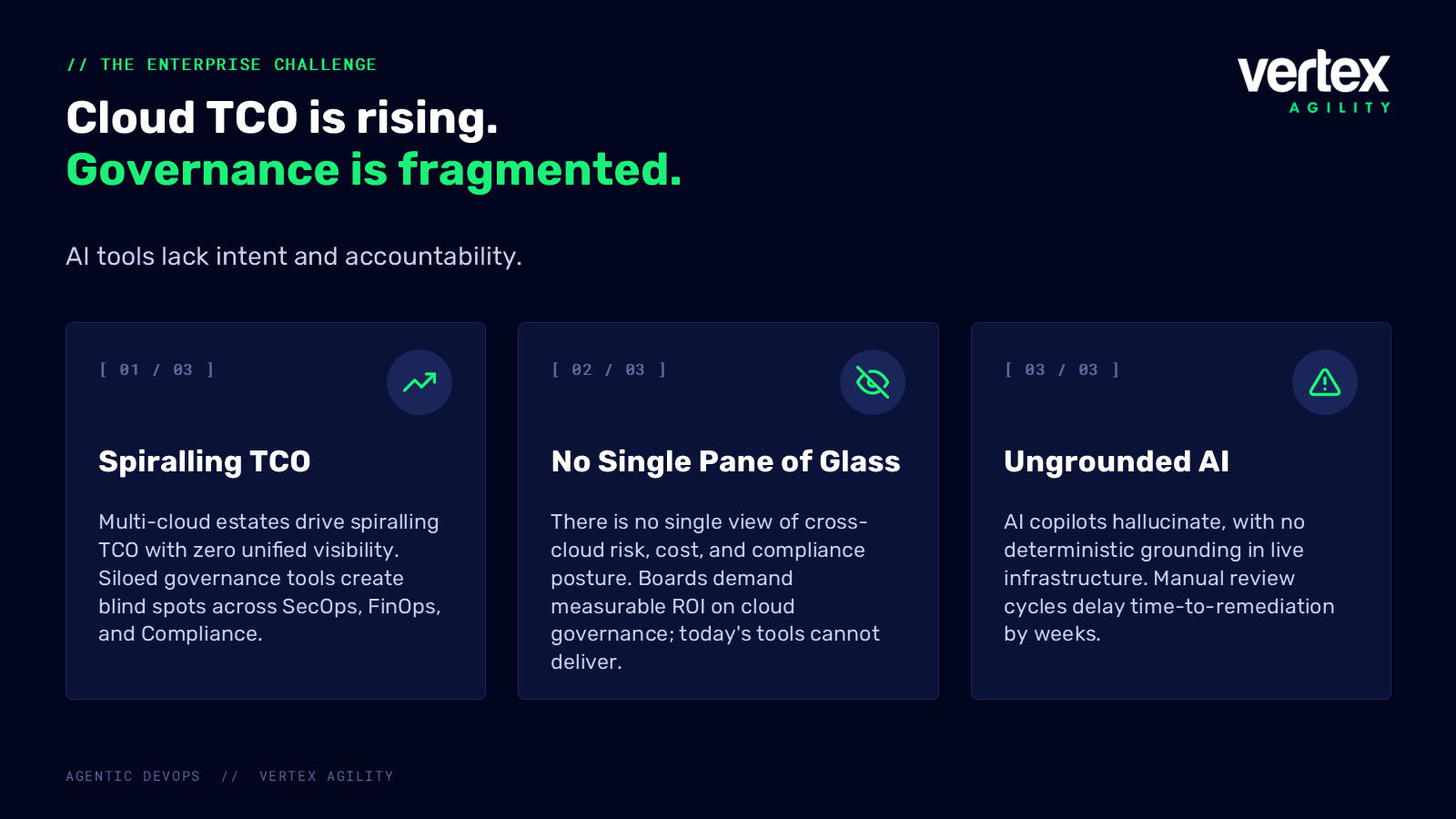
Total cost of ownership keeps climbing. Multi-cloud estates drive spiralling TCO with no unified view, and siloed tools leave blind spots between SecOps, FinOps, and compliance. A cost spike caused by a misconfigured resource is a security finding to one team and a budget variance to another. Often it’s nobody’s ticket.
There’s no single pane of glass. Nobody can see cross-cloud risk, cost, and compliance posture in one place. Boards want measurable ROI on cloud governance, and today’s tools can’t produce it because none of them owns the whole picture.
AI hasn’t closed the gap. The copilots added to cloud consoles hallucinate, and they’ve no deterministic grounding in the live infrastructure they’re describing. So every recommendation goes back through manual review, and time-to-remediation is still measured in weeks.
Fragmented governance rarely fails loudly. It leaks cost, risk, and audit findings that nobody owns from end to end.
Why Copilots Haven’t Fixed It
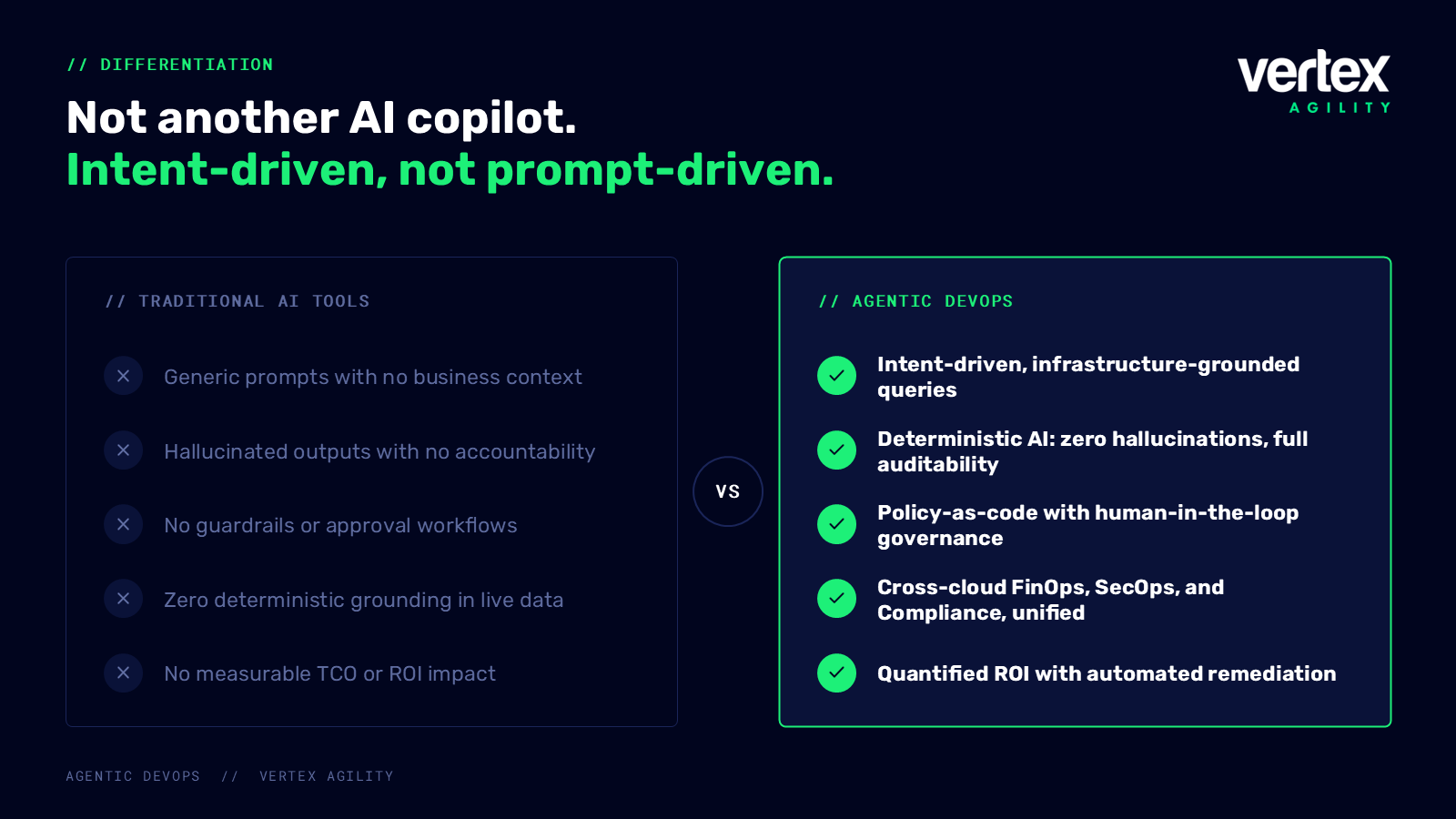
The obvious move is a chat interface over the estate. Most AI tooling in this space does exactly that, and it’s why the numbers haven’t moved. A copilot takes a generic prompt with no business context, returns an answer nobody’s accountable for, and has no guardrails or approval workflow around whatever happens next. We’ve written before about how governance built for chatbots breaks once agents start executing, and cloud operations is where that bites first.
Agentic DevOps is intent-driven rather than prompt-driven. Queries are grounded in your infrastructure and your business context, and they’re answered from live data instead of from whatever a model remembers. That’s what we mean by deterministic AI. Every answer is traceable to its source, which is how the platform holds a 0% hallucination rate with full auditability.
An AI that can’t show its working has no business changing your infrastructure. Grounding and auditability come first. Autonomy gets built on top of them.
What Agentic DevOps Does
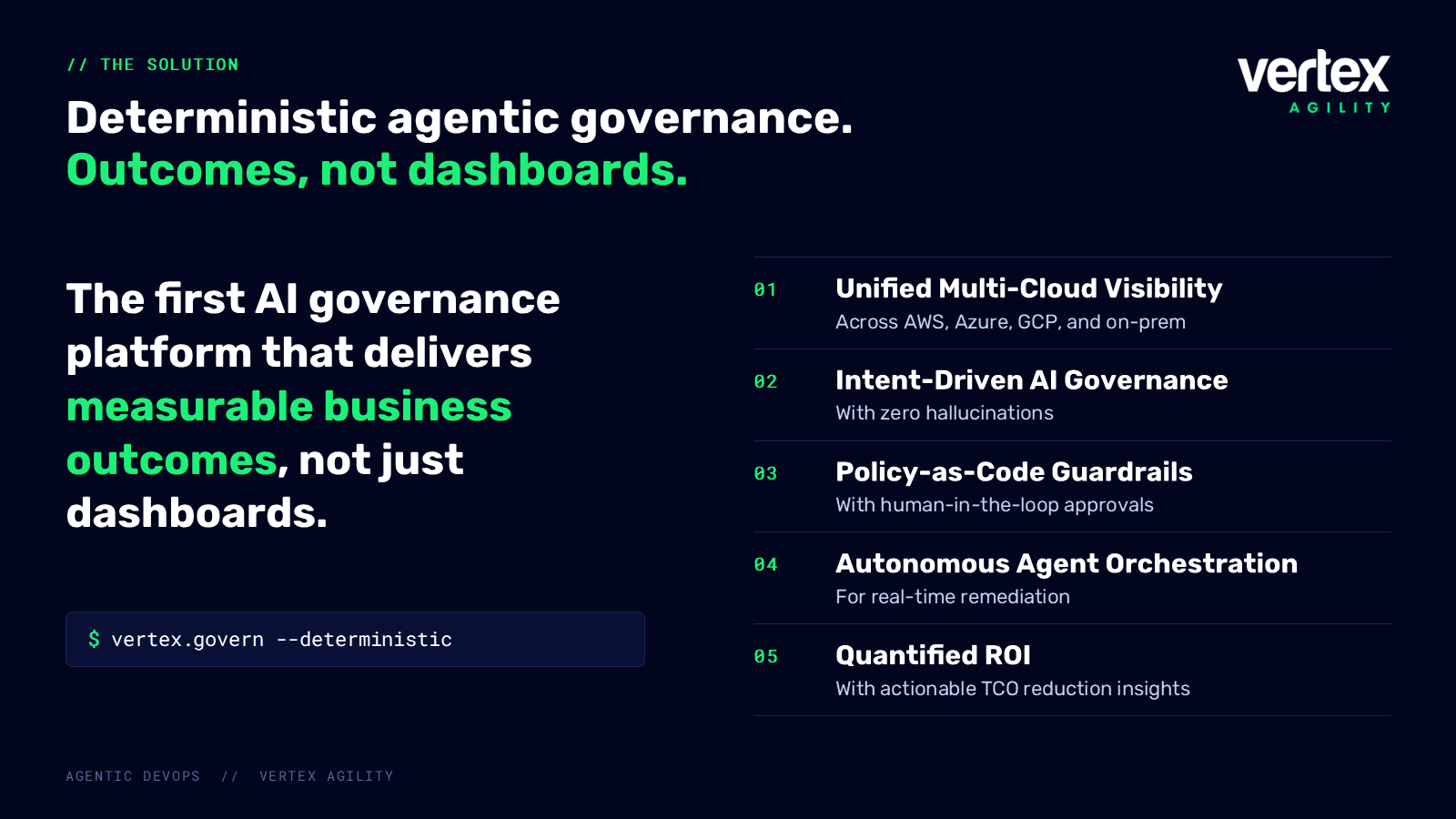
Five capabilities do the work. The platform gives you unified visibility across AWS, Azure, GCP, and on-premise estates, so cost, risk, and compliance are measured against one inventory instead of three. Its governance is intent-driven, with zero hallucinations, which makes its findings safe to act on. Your rules live as policy-as-code guardrails with human-in-the-loop approvals, enforced the same way on every cloud. Agents orchestrate remediation in real time rather than filing tickets. And everything rolls up into quantified ROI, with TCO reduction insights you can act on.
That last capability matters most to the people who sign off the budget. Governance that can’t show its return is the first line cut in a tight budget round.
One Gateway, Six Agents
At the centre sits the AgentCore Gateway, built on Amazon Bedrock AgentCore. It’s a centralised orchestration layer that connects 15+ data sources across every cloud estate and routes each request deterministically. Routing is zero-credential, so the agents reach your estates through the gateway instead of carrying cloud keys of their own.
That detail matters more than it sounds. Agents running on borrowed or shared credentials are one of the fastest-growing risks in the enterprise, as we argued in AI Agents Are Insiders Now. A governance platform made of agents has to be the best-governed agent estate you run.
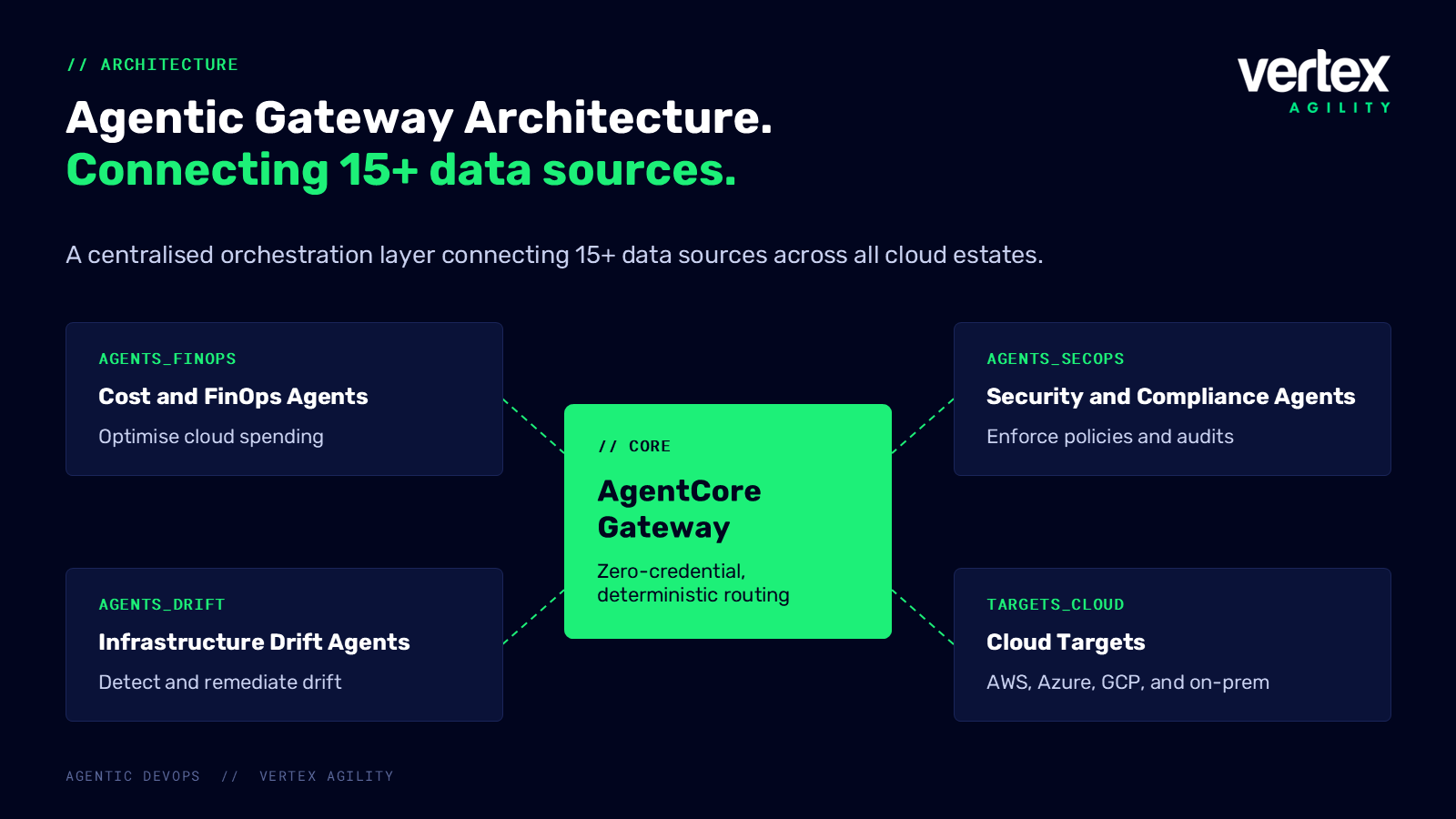
Three groups of agents work through the gateway: cost and FinOps agents that optimise cloud spending, infrastructure drift agents that detect and remediate drift, and security and compliance agents that enforce policies and audits. Their targets are your AWS, Azure, GCP, and on-premise estates.
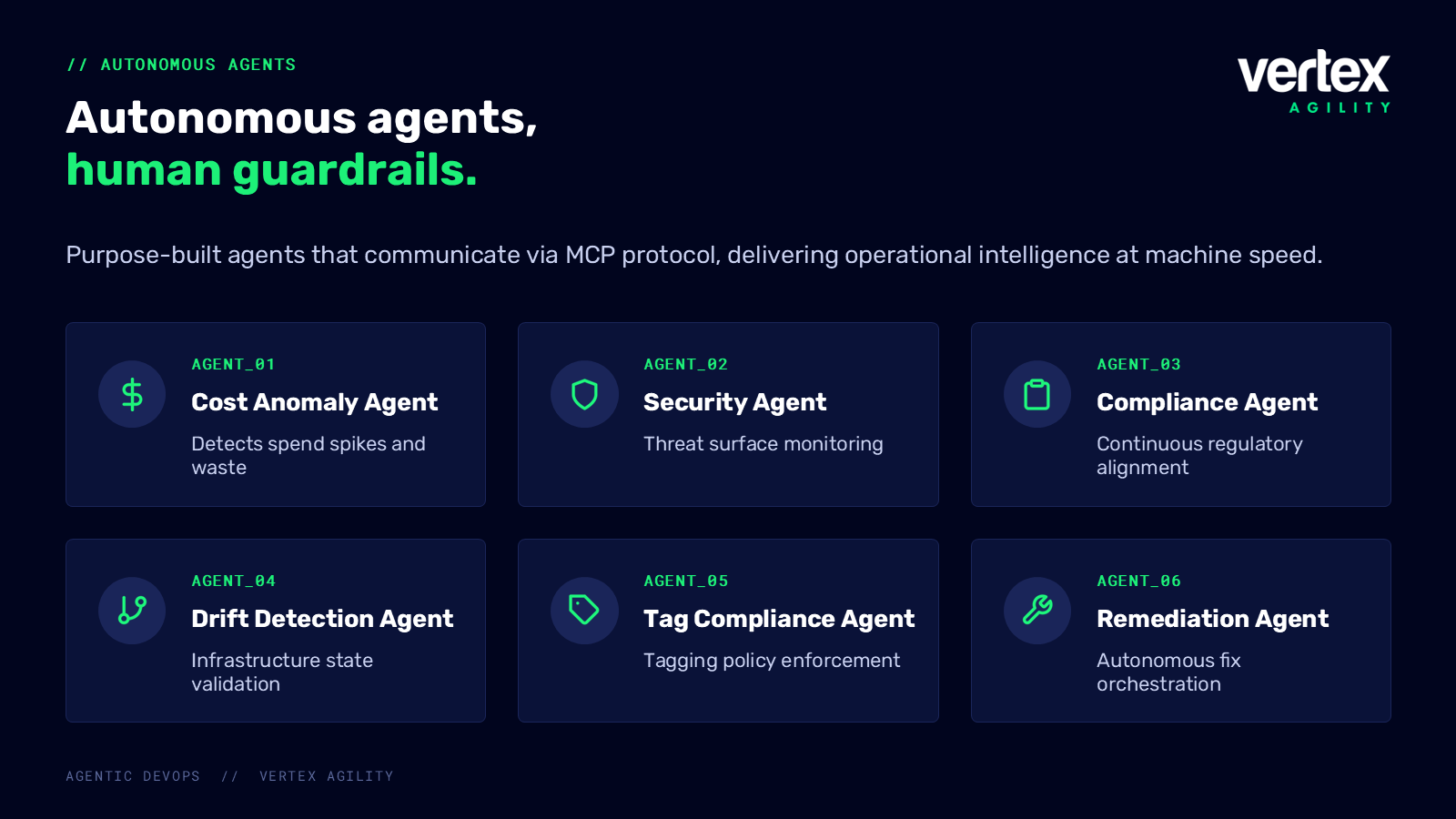
Inside those groups are six purpose-built agents. They communicate over the Model Context Protocol (MCP) and deliver operational intelligence at machine speed.
- Cost Anomaly Agent detects spend spikes and waste.
- Security Agent monitors the threat surface.
- Compliance Agent keeps you in continuous regulatory alignment.
- Drift Detection Agent validates infrastructure state against what it should be.
- Tag Compliance Agent enforces your tagging policy, the unglamorous foundation every cost allocation depends on.
- Remediation Agent orchestrates the fixes.
Where People Stay in Charge
Autonomy is where most organisations get nervous, and they’re right to. An agent that can remediate can also break things. One that can change resources can also change the bill.
So the guardrails are part of the design. The agents work inside policies you write as code, which means they’re versioned like any other code and enforced the same way on every cloud. Remediation runs through human-in-the-loop approval workflows, and every action and every approval is recorded for audit. Where a fix commits money, that approval step carries even more weight, a point we made in Your AI Agents Are About to Start Spending Your Money.
The agents do the watching and the fixing. People decide what changes.
One Pane of Glass for the Board
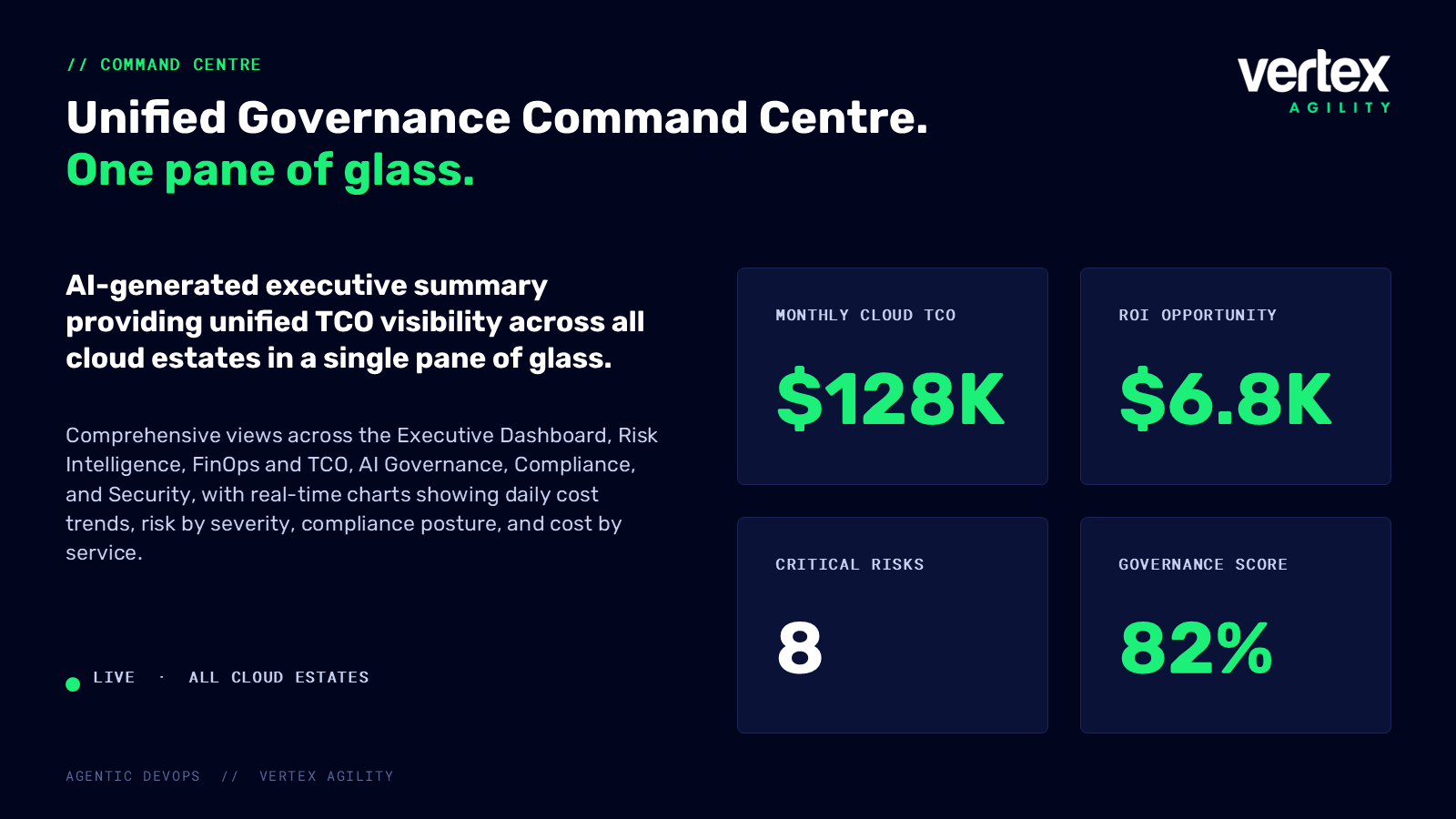
Everything the agents find rolls up into the Unified Governance Command Centre. An AI-generated executive summary gives unified TCO visibility across every cloud estate. Behind it sit views for the executive dashboard, risk intelligence, FinOps and TCO, AI governance, compliance, and security, with real-time charts for daily cost trends, risk by severity, compliance posture, and cost by service.
In the view below, a $128K monthly cloud TCO carries a $6.8K ROI opportunity, eight critical risks, and a governance score of 82%. That’s the conversation a board actually wants: what it costs, what it could save, what’s exposed, and how well it’s governed, from one source.
The Numbers We Hold It To
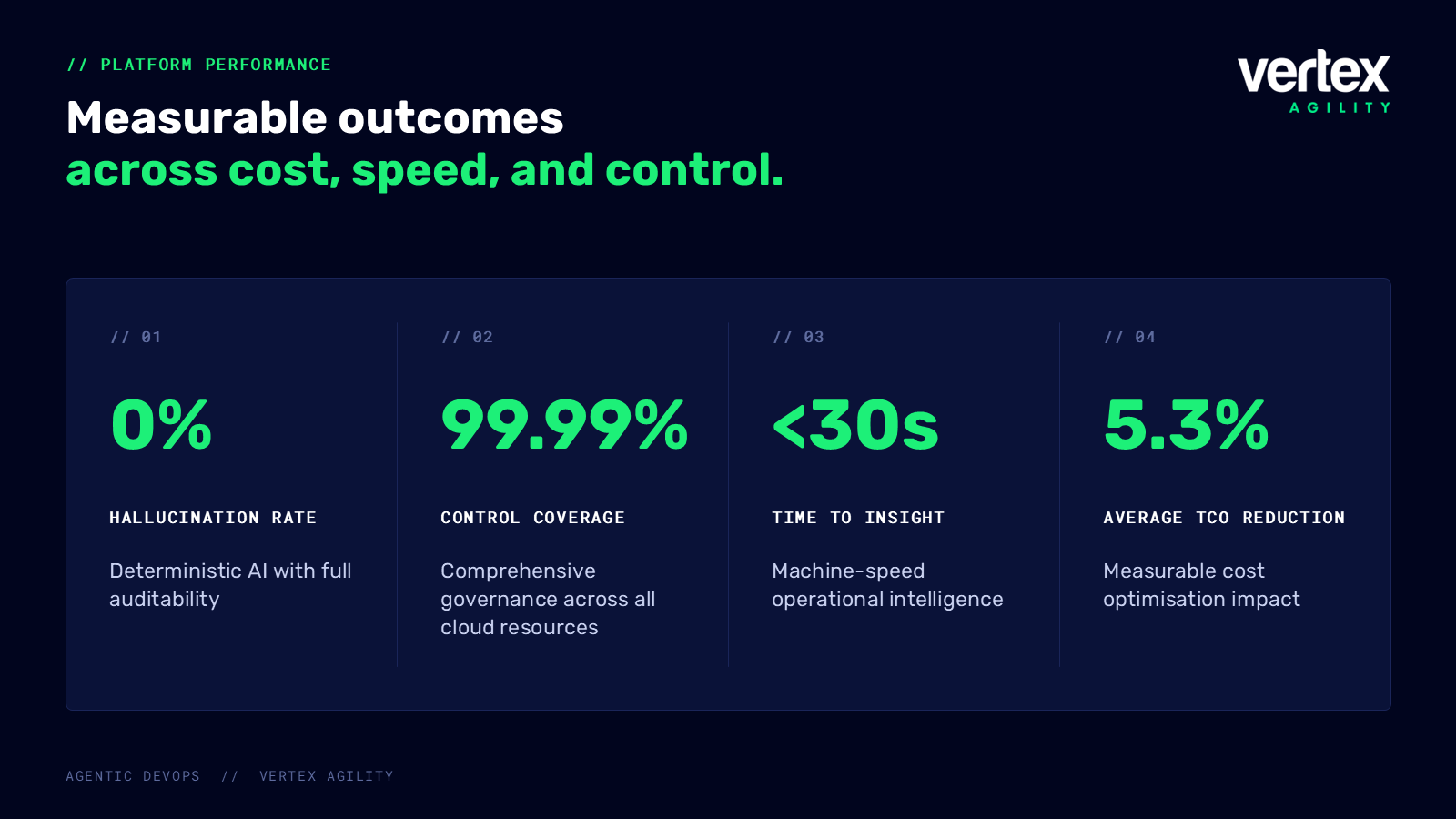
Four measures tell you whether the platform is doing its job.
0% hallucination rate. Deterministic AI with full auditability, because the answers come from live data.
99.99% control coverage. Governance across all of your cloud resources, rather than a sample of them.
Under 30 seconds to insight. Machine-speed operational intelligence, where the old review cycle took weeks.
5.3% average TCO reduction. A measurable cost optimisation impact across the estate. On an estate the size of the one above, that’s more than $80K a year.
Why Cloud Governance Is Going Agentic Now
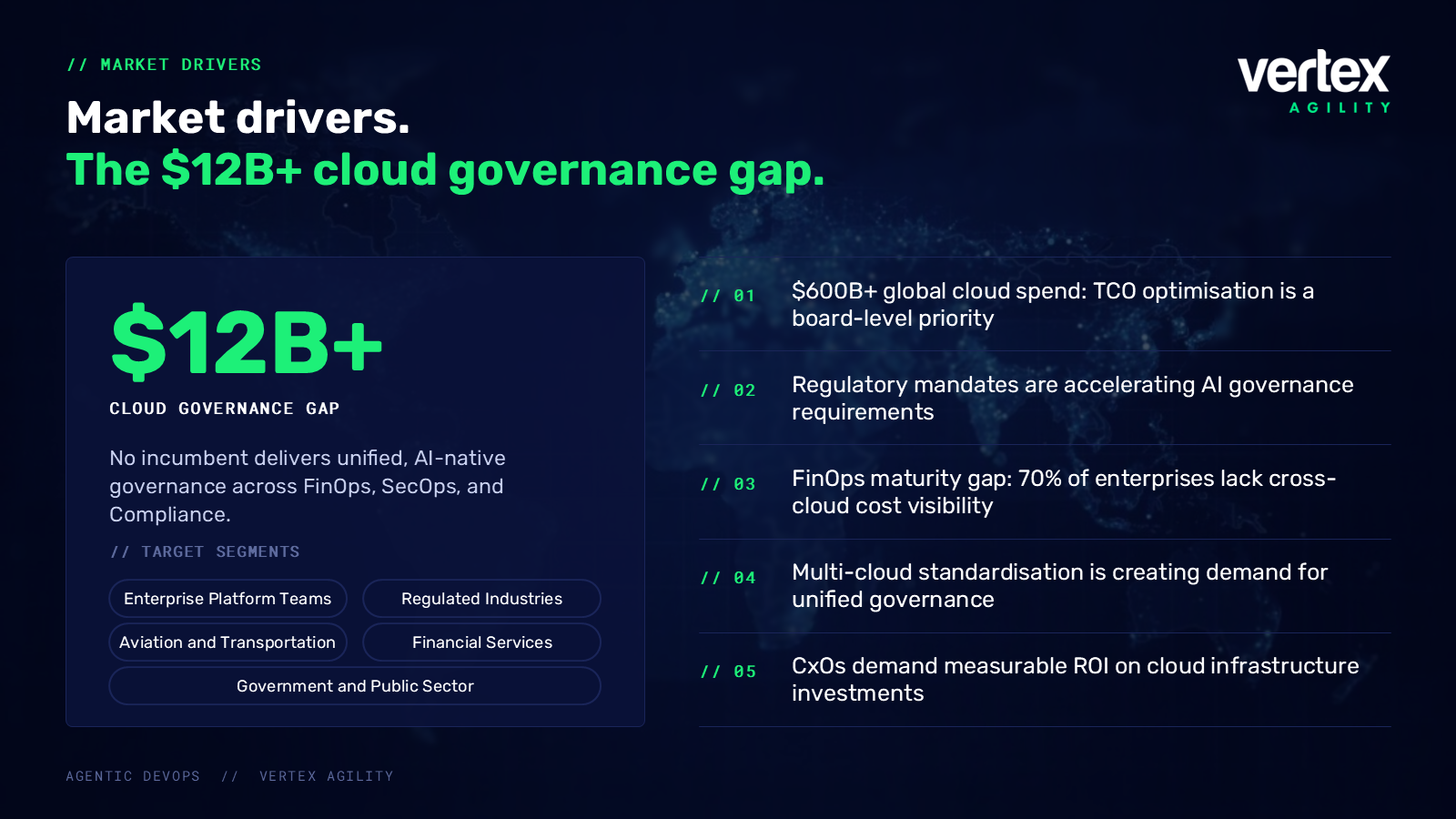
Our market analysis points to five pressures arriving at once. Global cloud spend has passed $600 billion, which has made TCO optimisation a board-level priority. Regulatory mandates are speeding up AI governance requirements. The FinOps maturity gap is wide, with 70% of enterprises lacking cross-cloud cost visibility. Multi-cloud standardisation is creating demand for unified governance. And CxOs expect measurable ROI on what they’ve spent on cloud infrastructure.
Together they add up to what we see as a $12B+ cloud governance gap, because no incumbent delivers unified, AI-native governance across FinOps, SecOps, and compliance. The organisations feeling it most are enterprise platform teams and regulated industries, especially aviation and transportation, financial services, and government and the public sector. Every one of those pressures lands on the same three teams that still can’t agree on what the estate contains.
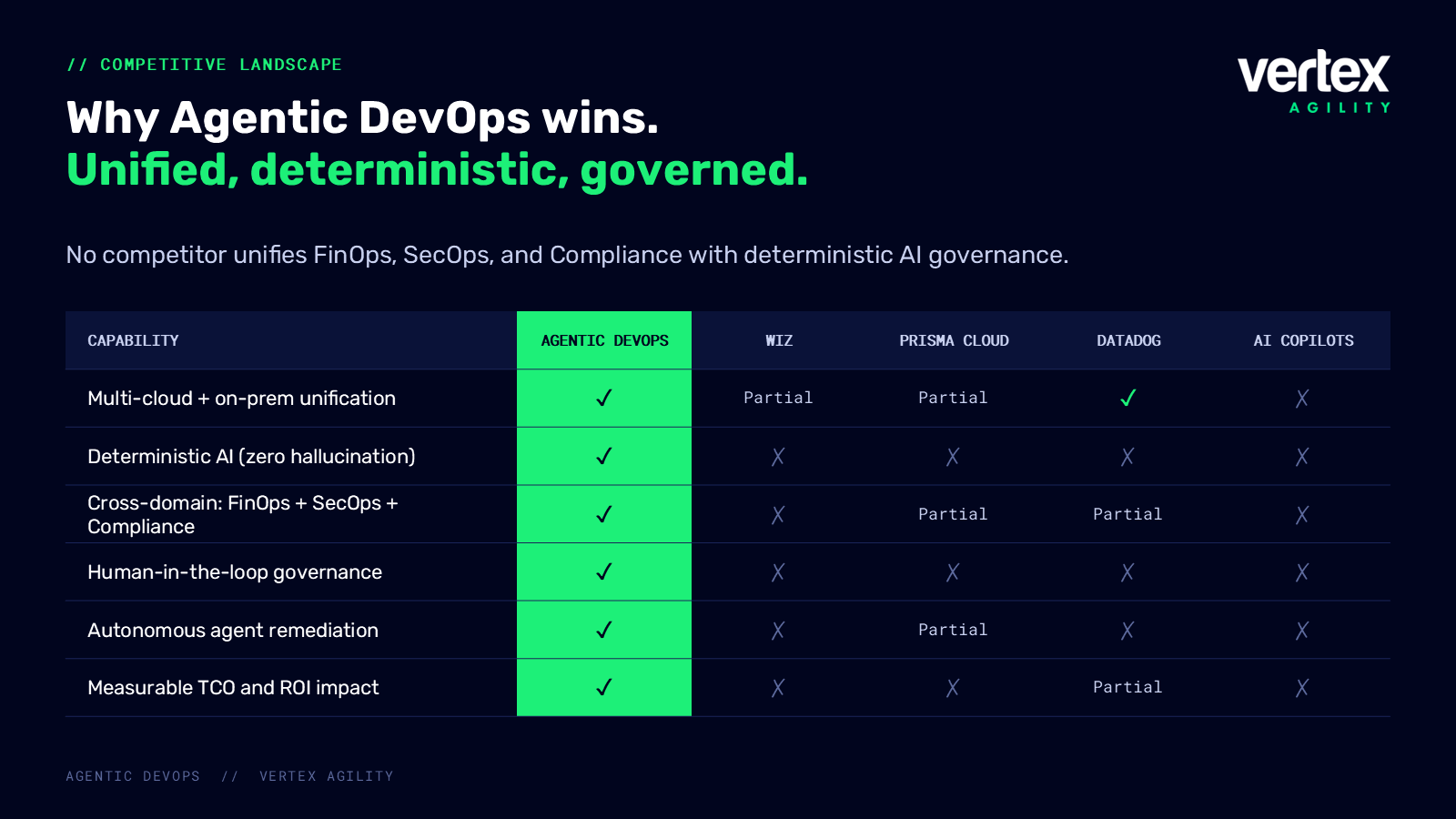
The gap is easiest to see side by side. Cloud security platforms, observability tools, and AI copilots each cover part of the picture, some more of it than others. None of them brings FinOps, SecOps, and compliance together under deterministic AI governance.
Where the Platform Goes Next
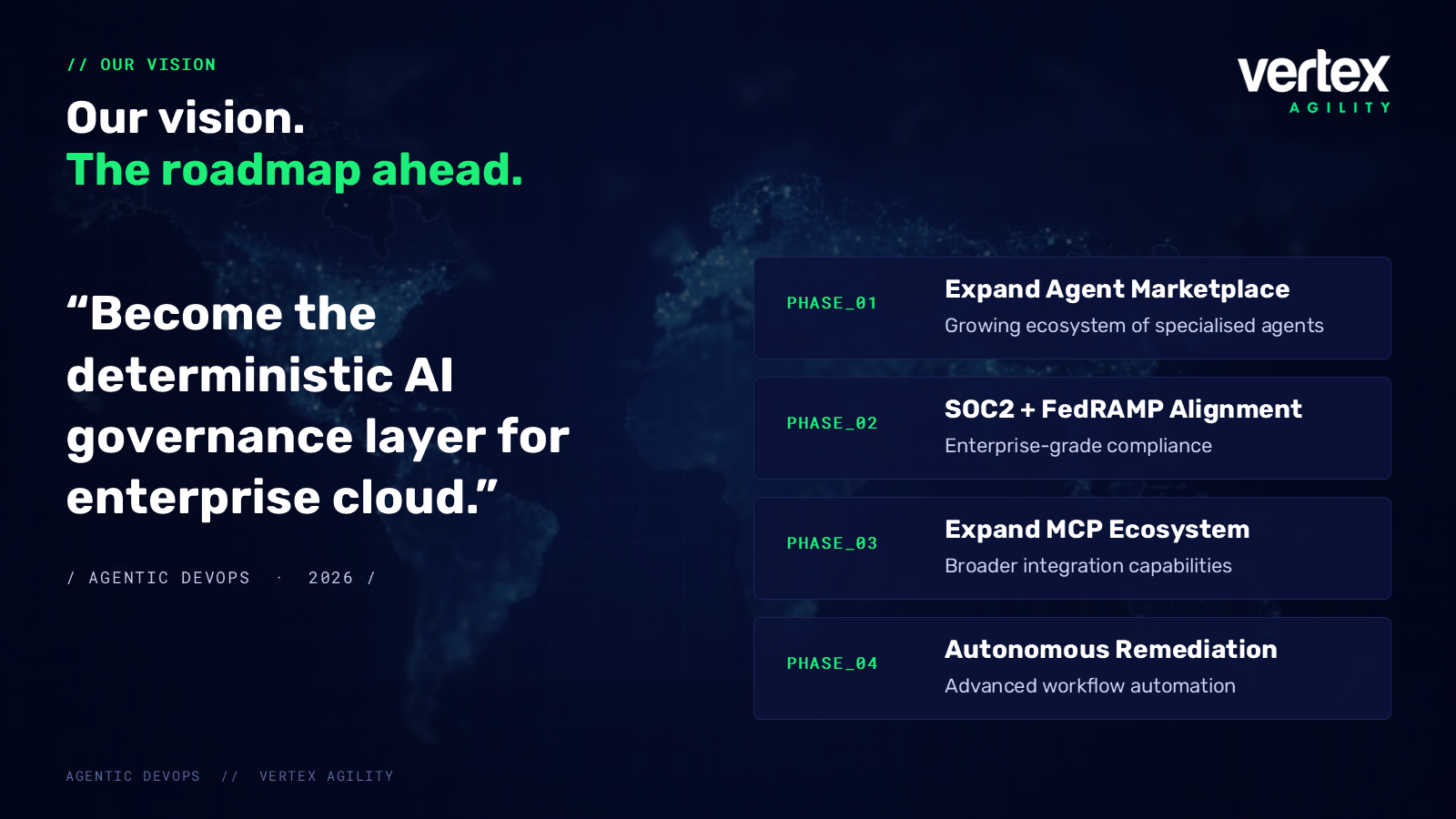
Our ambition for Agentic DevOps is easy to state. We want it to become the deterministic AI governance layer for enterprise cloud.
The 2026 roadmap has four phases: a bigger agent marketplace with more specialised agents, SOC2 and FedRAMP alignment for enterprise-grade compliance, broader MCP integration capabilities, and more advanced workflow automation for autonomous remediation. Each phase widens what the agents can do without changing who approves it.
How to Start
Agentic DevOps is available through pilot programmes, enterprise licensing, and strategic partnerships.
A pilot programme connects the platform to a defined part of your estate. You see the agents, the guardrails, and the command centre working on your own infrastructure, and you measure the results against your own baseline before you commit further. An enterprise licence then takes the platform across the whole estate. And if you’re a partner rather than an end client, we offer strategic partnerships as well.
If your estate isn’t ready for agents yet, start with visibility. Our series on using AI and automation to take control of your technology costs covers the groundwork, beginning with AI-driven cost and usage visibility. Agents can only govern what you can already see.
Q&A: Agentic DevOps and Multi-Cloud Governance
What is Agentic DevOps?
A multi-cloud governance platform built on Amazon Bedrock AgentCore. Purpose-built AI agents monitor and remediate cost, security, compliance, and infrastructure drift across AWS, Azure, GCP, and on-premise estates. They’re grounded in live infrastructure data and work inside policy-as-code guardrails and human-in-the-loop approvals.
How is it different from an AI copilot?
A copilot answers generic prompts with no business context and no accountability for what happens next. Agentic DevOps is intent-driven: queries are grounded in your live infrastructure, answers are deterministic and auditable, and remediation runs through policy-as-code guardrails and human approvals, with the return measured in TCO and ROI.
What does a 0% hallucination rate mean in practice?
The platform answers from live infrastructure data through deterministic routing, instead of generating answers from what a model remembers. Every answer is traceable to its source and fully auditable, so its findings are safe to act on.
Will the agents change our infrastructure without approval?
The agents work inside guardrails you define as policy-as-code, and remediation runs through human-in-the-loop approval workflows. Every action and every approval is recorded, so you keep a full audit trail of what changed and who signed it off.
Which clouds and data sources does it cover?
AWS, Azure, GCP, and on-premise estates. The AgentCore Gateway connects 15+ data sources through a single orchestration layer, and the agents communicate over the Model Context Protocol (MCP).
How do we get started with Agentic DevOps?
Most organisations start with a pilot programme on a defined part of their estate, then move to an enterprise licence across the whole of it. Strategic partnerships are also available for partners.
Working Through This With Vertex Agility
As an AI-native transformation consultancy, we see cloud governance fail in the gaps between teams far more often than inside any one of them. That’s why Agentic DevOps sits in our Cross-Cutting Services: it works across your FinOps, security, compliance, and platform teams rather than belonging to one of them. Where you want people working alongside the agents on spend, it pairs with our Cloud Cost Engineering Service.
To see how ready your organisation is to put agents to work on its estate, our free AI Readiness Audit scores your governance and cost discipline alongside your strategy, data, and skills. It takes minutes, and it’s a good place to start the pilot conversation.