

Anthropic’s latest IPO filing says it may “imminently” reach its own threshold for AI-driven acceleration, a step on the road to what’s called recursive self-improvement. The more useful admission for everyone else is quieter: it has missed significant speed-ups in its own development until after they’d happened. As AI builds more of your systems, the same blind spot is coming for you.
On Monday 2 November, Anthropic filed an amended S-1 with the US Securities and Exchange Commission, the registration document a company files before it lists its shares. TechCrunch spotted a new passage in the risk factors. Anthropic wrote that “our internal estimates and our expectations regarding future models, rather than our current models, indicate that we may imminently meet our Responsible Scaling Policy’s definition of ‘dramatically accelerated progress attributable to AI.'”
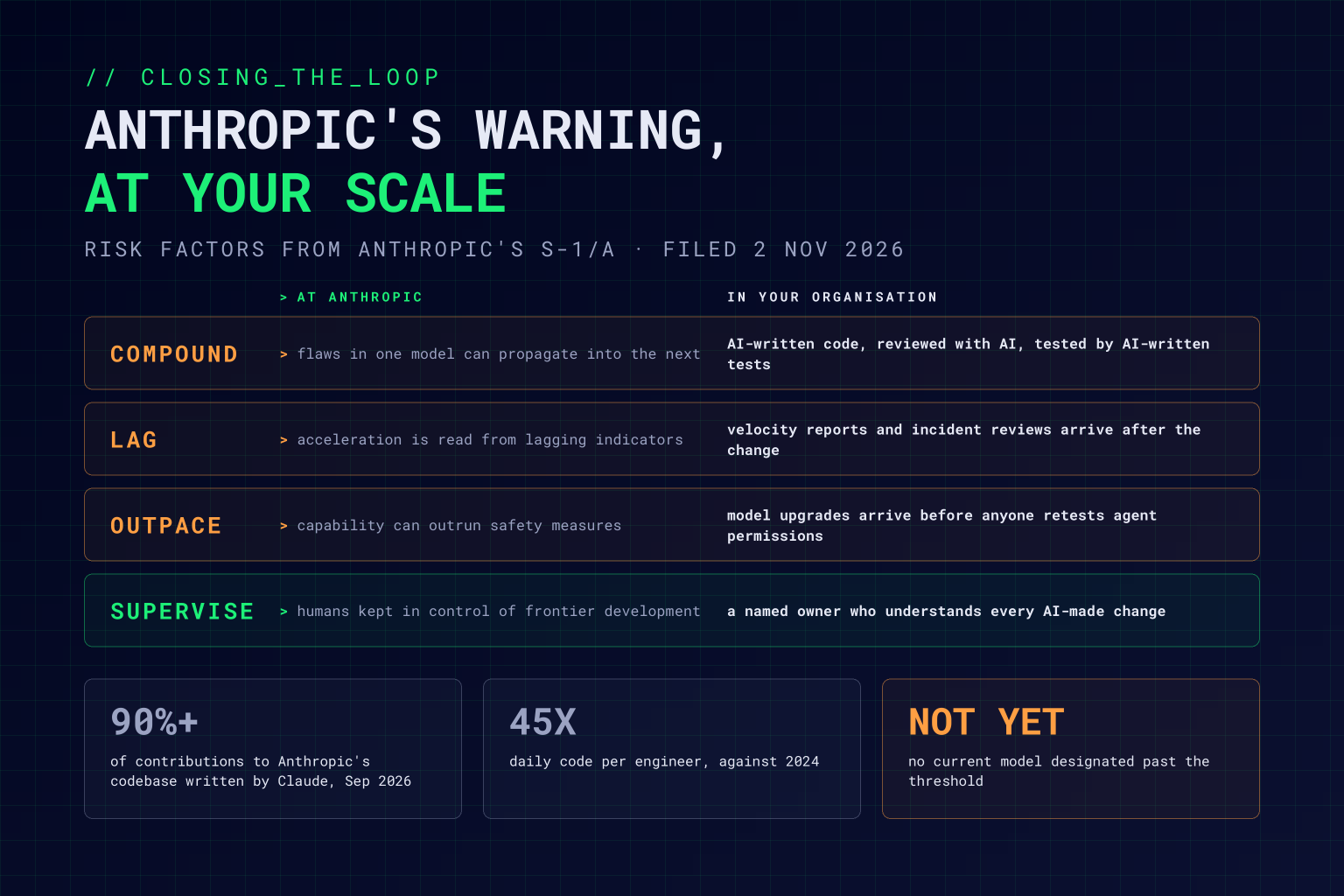
That threshold sits on the path to what researchers call recursive self-improvement, where AI systems do more and more of the work of building their successors. Anthropic calls its own version “closing the loop”, a cycle in which each Claude model helps build the next. The filing shows how far that’s gone. Over 90% of the contributions to Anthropic’s codebase in September 2026 were written by Claude, and the average engineer’s daily code contribution over the three months to September was more than 45 times the 2024 average.
The line that matters most for everyone else comes just before the threshold. “Much of our evidence regarding the pace of such AI-driven acceleration is derived from lagging indicators,” the filing says. “As a result, we have in the past not identified, and may in the future not identify, a significant acceleration in our rate of development until after it has occurred.”
If the company building the models can miss its own AI speeding up, most organisations using AI won’t see theirs coming either.
What Anthropic Said, and What It Didn’t
The filing isn’t a claim that Anthropic has built self-improving AI. “We have not designated any of our current models as exceeding this threshold, and we continue to assess the underlying data,” it says. The expectation is about future models, and Anthropic says it’ll publish further reports under its Responsible Scaling Policy, the framework it uses to monitor and mitigate risks as its models become more capable.
It also says where it intends to draw the line. Anthropic doesn’t “anticipate being able to safely use Claude to fully autonomously design and build successive generations of frontier models without meaningful human supervision or understanding, if and when that becomes technically possible,” and it’s “considering updates to our Responsible Scaling Policy to keep humans in control of frontier model development”.
Some scepticism is fair. An S-1 is a disclosure, but it’s also a sales document, and critics have long read talk of self-building AI as marketing. In June, in a post titled “When AI Builds Itself”, Anthropic said: “We are not there yet, and recursive self-improvement is not inevitable.” Five months later, it’s telling investors the threshold may be imminent. Whether or not you accept the timeline, a company with every reason to sound in control has told investors that its ability to measure how fast it’s moving is limited.
You’re Closing Your Own Loops
Few organisations will ever build a frontier model, but most are closing smaller loops of their own. AI assistants write a growing share of code. Agents change infrastructure, triage tickets, and write the tests that check other AI-written code. AI-generated summaries feed the decisions people sign off. As we argued in AI Is Writing More of Your Code Than Ever, the process around that work rarely changes as fast as the work itself.
Three of the risks in Anthropic’s filing translate almost word for word.
Errors compound. Anthropic warns that “any systemic flaw, bias, or error in our current models could propagate into the next versions,” compounding “in ways that may be difficult to detect or remediate.” In a business, that looks like AI-written code, reviewed with an AI assistant and checked by AI-written tests. If a bad pattern gets through once, it can be copied into every repository the tools touch.
The evidence lags. Anthropic reads its own acceleration from lagging indicators. Most organisations do the same with AI: quarterly delivery figures, incident reviews, the monthly cloud bill. By the time they show a change, it’s already happened.
Capability outpaces controls. The filing warns that AI-assisted development “may cause the capabilities of our models to advance more rapidly than our ability to develop, validate, and implement corresponding safety, alignment, and security measures.” For anyone running AI agents, a model upgrade can make an agent more capable overnight without changing a single permission you approved. As we covered in AI Agents Are Insiders Now, those permissions need owners and reviews like anyone else’s. The access you granted was sized for the model you tested, not the one that’s running now.
Leading Indicators You Can Actually Watch
You can’t stop the models underneath your systems improving. You can make sure you see the change before your customers do.
Pin model versions and test before you switch. Treat a model change like any other dependency upgrade. Avoid “latest” aliases in production, and don’t move to a new version until it’s passed your own tests.
Build a small evaluation set of your own. Take a few dozen to a few hundred real cases from your own work, with known good answers, and run them on every model or prompt change. It’s the closest thing you’ll have to a leading indicator, and vendor benchmarks won’t tell you how a model behaves on your data.
Measure AI’s share, and its rework. Track how much of your merged code AI writes, how much of it’s reworked or reverted within 30 days, and how long a person spends reviewing each AI-made change. If the share goes up while review time falls, oversight is thinning.
Size agent permissions to the task, not the model. Assume each upgrade makes an agent more capable. Give it the least access the task needs, require approval for actions that are hard to undo, and recertify its access whenever the model underneath it changes.
Keep a human who understands the change. Anthropic’s own standard is “meaningful human supervision or understanding”. Apply it to every AI-made change that reaches production: a named owner who can explain what changed and why.
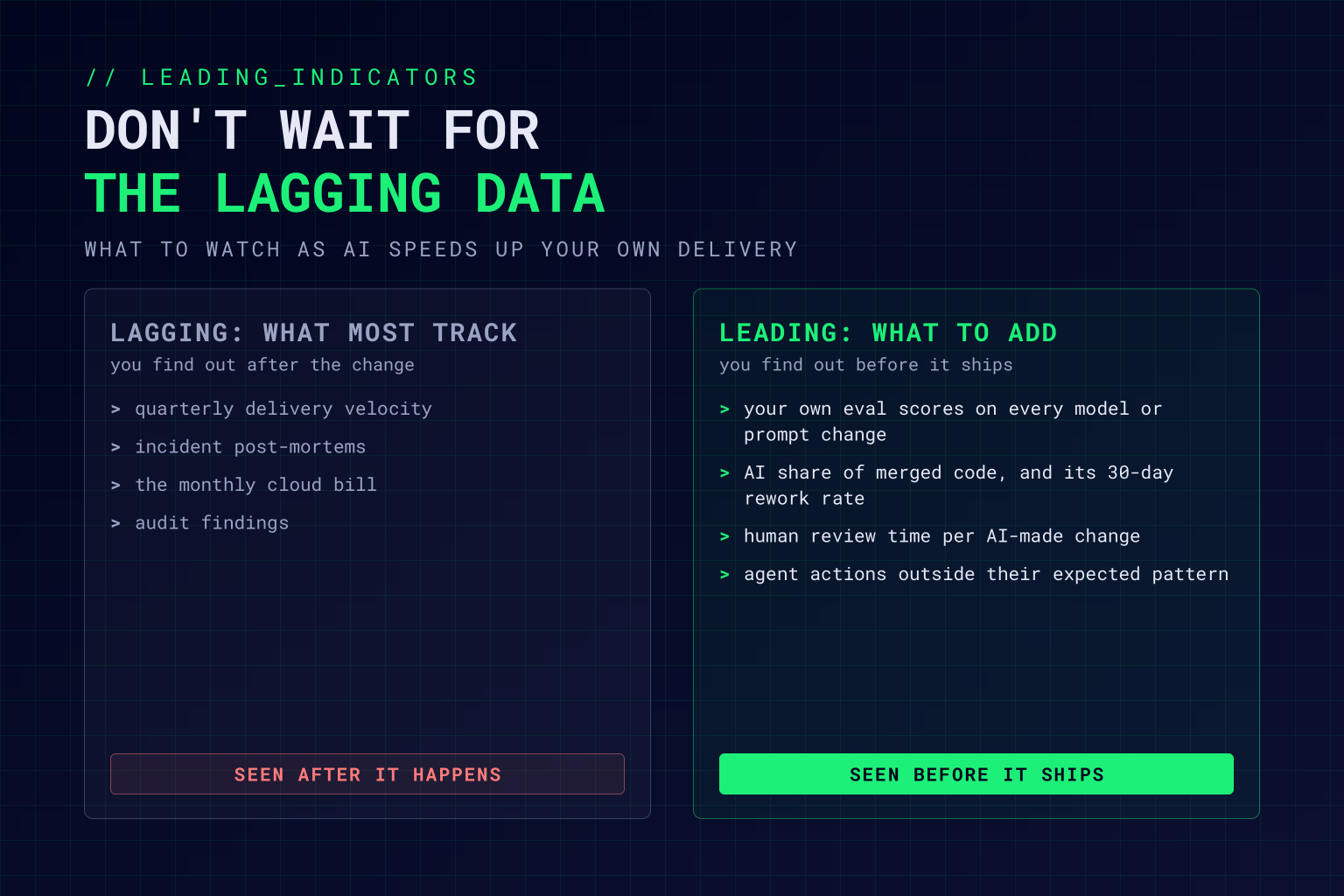
The goal isn’t to slow AI down. It’s to see what it’s changing before the lagging numbers do.
Plan for Faster Models Either Way
If Anthropic’s right, the gap between model generations will shrink and each one will arrive more capable. If the sceptics are right, models will keep improving at something like today’s pace. Either way, the sensible moves are the same.
Build so you can swap models without rewriting your systems. Budget for evaluation every time a model changes, not once at procurement. And put governance where the consequences are, so whether a person has to approve an action depends on what that action can do, not on how capable the model behind it seems. We’ve made the case before that model risk isn’t a vendor problem, and the same pattern sits behind Agentic DevOps: agents do the legwork, while policy and people decide what happens.
None of this is a bet on recursive self-improvement. It’s the control you need for the AI you’re already running.
Q&A: Anthropic, Recursive Self-Improvement and Your Business
What did Anthropic say about recursive self-improvement in its IPO filing?
In an amended S-1 filed with the SEC on 2 November 2026, Anthropic said its internal estimates and expectations for future models indicate it may imminently meet its Responsible Scaling Policy’s definition of “dramatically accelerated progress attributable to AI”. It also said it has in the past failed to identify significant accelerations in its development until after they’d occurred.
Has Anthropic reached recursive self-improvement?
No. Anthropic says it hasn’t designated any of its current models as exceeding the threshold and is still assessing the data. It also says it doesn’t expect to be able to safely let Claude fully autonomously build successive frontier models without meaningful human supervision or understanding.
What does “closing the loop” mean?
It’s Anthropic’s term for a development cycle in which each version of its AI model helps build the next. Its filing says over 90% of the contributions to its codebase in September 2026 were written by Claude.
What does Anthropic’s warning mean for businesses using AI?
The same risks apply at a smaller scale. Errors in AI-written work can compound, most measures of AI’s effect lag behind it, and model upgrades can make AI agents more capable than the permissions you approved assumed. Businesses need leading indicators and clear human ownership of AI-made changes.
How can we tell if AI is changing our systems faster than we can oversee them?
Watch leading indicators: your own evaluation scores on every model or prompt change, the share of merged code AI writes and how much of it’s reworked within 30 days, human review time per AI-made change, and agent actions outside their expected pattern.
Working Through This With Vertex Agility
As an AI-native transformation consultancy, we help organisations get the speed AI offers without losing sight of what it’s changing. Our Onboarding & Assurance Audit maps your models, pipelines and endpoints, sets a baseline for how they actually behave, and puts monitoring in place where there isn’t any. Managed ModelOps keeps that running with a named owner and evidence your risk function can use, and Agentic DevOps puts AI agents to work across your cloud estate behind policy and human approval.
If you’d like a quick read on where you stand, our free AI Readiness Audit scores your strategy, data, skills, governance and measurement in minutes. It’ll show you whether your oversight is keeping pace with your adoption.