

Search for an AI readiness assessment and you’ll find plenty of free ones, from Microsoft, Cisco, Google, Thoughtworks and consultancies like ours. They look alike, but they don’t measure the same things. We read what each tool says it scores, and found one gap they all share: none of them asks about the AI agents you’re already running.
An AI readiness assessment used to answer one question: are you ready to start? Do you have a strategy, the data, the skills and the infrastructure to put AI to work? For a growing number of organisations, that question’s already been overtaken. They started some time ago, and the question now is whether they can control what they’ve started.
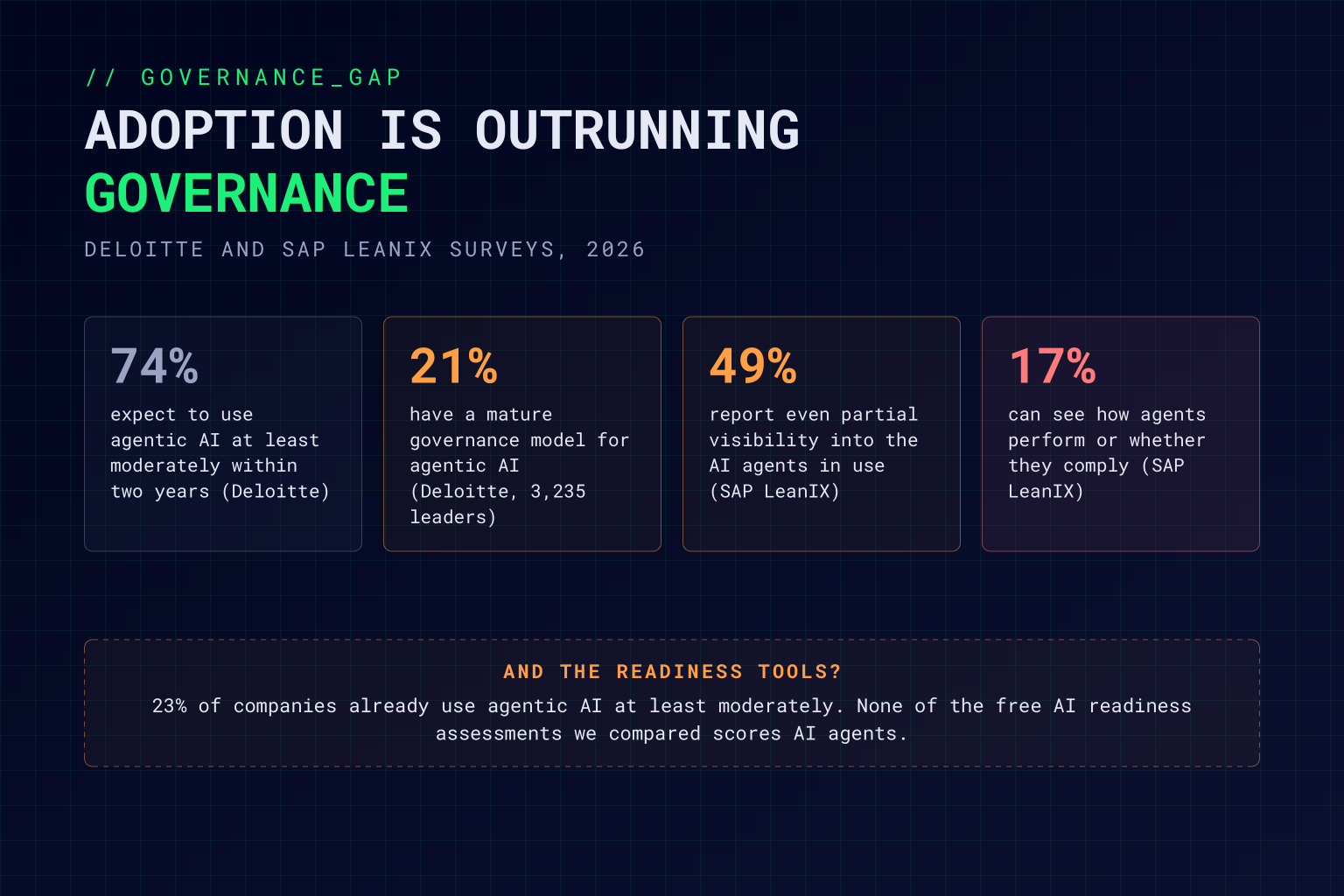
The research says most can’t yet. Deloitte’s State of AI in the Enterprise survey of 3,235 business and IT leaders across 24 countries found that 23% of companies already use agentic AI at least moderately, and 74% expect to within two years. Only 21% have a mature governance model for agentic AI. SAP LeanIX surveyed 228 enterprise architects and IT decision-makers in March 2026. Slightly less than half, 49%, report even partial visibility into the AI agents in use. 48% have no clear roles or responsibilities for agents, and only 17% can see how agents perform or whether they comply.
Adoption is outrunning governance, so a readiness score that leaves governance out is answering last year’s question.
What the Free AI Readiness Assessments Measure
We read the primary page of each free, public tool that turns up for “AI readiness assessment” and recorded what it says it scores, how long it takes, and what you get at the end. Where a page doesn’t say, we’ve said so rather than guess. We’ve included our own, on the same terms.
| Assessment | What it scores | What you get | Governance | AI agents |
|---|---|---|---|---|
| Microsoft AI Readiness Assessment (Microsoft Learn), about 45 minutes | Seven pillars: business strategy, AI strategy and experience, organisation and culture, AI governance and security, data foundations, infrastructure for AI, model management | A score with personalised recommendations | Its own pillar | Not mentioned |
| Cisco AI Readiness Index assessment tool, time not stated | Six pillars: strategy, infrastructure, data, governance, talent, culture. Take all six or pick some | A score per pillar and a band from Pacesetter to Laggard, against Cisco’s global index | Its own pillar | Not mentioned |
| Thoughtworks AI Readiness Assessment, time not stated | Six dimensions: foundational architecture, operating model, ready data, experiences for humans and AI, strategic alignment, trustworthy AI | A personalised maturity report, sent by email | Under “trustworthy AI”, which the page doesn’t define | Not a dimension |
| Google Gen AI Navigator, time not stated | Three sections: strategy, infrastructure, skills, set against your industry | A score out of 5 per section against an all-industry average. The full report asks for your details | Not covered | Not covered |
| Vertex Agility AI Readiness Audit, about five minutes | Six areas: strategy and vision, data and infrastructure, talent and capability, use cases and implementation, governance and risk, measurement and cost management | A maturity level per area and a personalised report, on screen and by email | Its own area | Not asked |
Two of the bigger names don’t appear because we couldn’t find a free, public self-check to compare. Accenture launched an AI Adoption Maturity Model with Carnegie Mellon University’s Software Engineering Institute in June 2026. It has eight dimensions, including risk and governance, five maturity levels, and an accompanying assessment tool, but it’s a structured framework rather than a five-minute check. Deloitte publishes its research as reports. Google’s AI Adoption Framework and AWS’s Cloud Adoption Framework for AI are whitepapers, not questionnaires.
The UK nearly had one built around governance. The Department for Science, Innovation and Technology consulted on an AI Management Essentials self-assessment for organisations, then said in February 2026 that “DSIT will not be publishing AIME”. It plans foundational governance guidance for smaller businesses instead.
What the Table Tells You
They share the same foundations. Strategy, data, infrastructure, skills and culture appear in almost every tool, under slightly different names. That’s no criticism. Those foundations decide whether AI gets anywhere at all. But they’re also the easiest questions to answer optimistically, because a strategy deck or a data platform roadmap can make a yes feel true.
Governance is a pillar name, not a guarantee. Microsoft and Cisco give governance its own pillar, as do we, and Accenture’s model has risk and governance as a dimension. A pillar name doesn’t tell you whether it asks about a policy or about a control that works. Our own governance section asks whether you have frameworks or processes for AI governance or ethical use. That’s a fair question, and it’s a question about policy.
None of them asks about agents. Not Microsoft’s, not Cisco’s, not Thoughtworks’, not Google’s, and not ours. Each tool was built to judge whether an organisation could adopt AI. Agents that act on your systems, with their own access, raise a different question that a readiness score doesn’t yet reach. A readiness score that never asks about agents can tell you you’re ready while agents run with nobody’s name on them.
Cost rarely gets a line. Of the tools above, ours is the only one whose page names cost management as a scored area: whether you can attribute technology costs to outcomes, and whether you’d spot abnormal usage and spend. We’d argue it belongs in every assessment. As we set out last week in What Uber Should Have Measured, AI spend that can’t be tied to outcomes is the quickest way to lose the board’s confidence in a programme that might be working.
Five Agent Questions to Add to Any Assessment
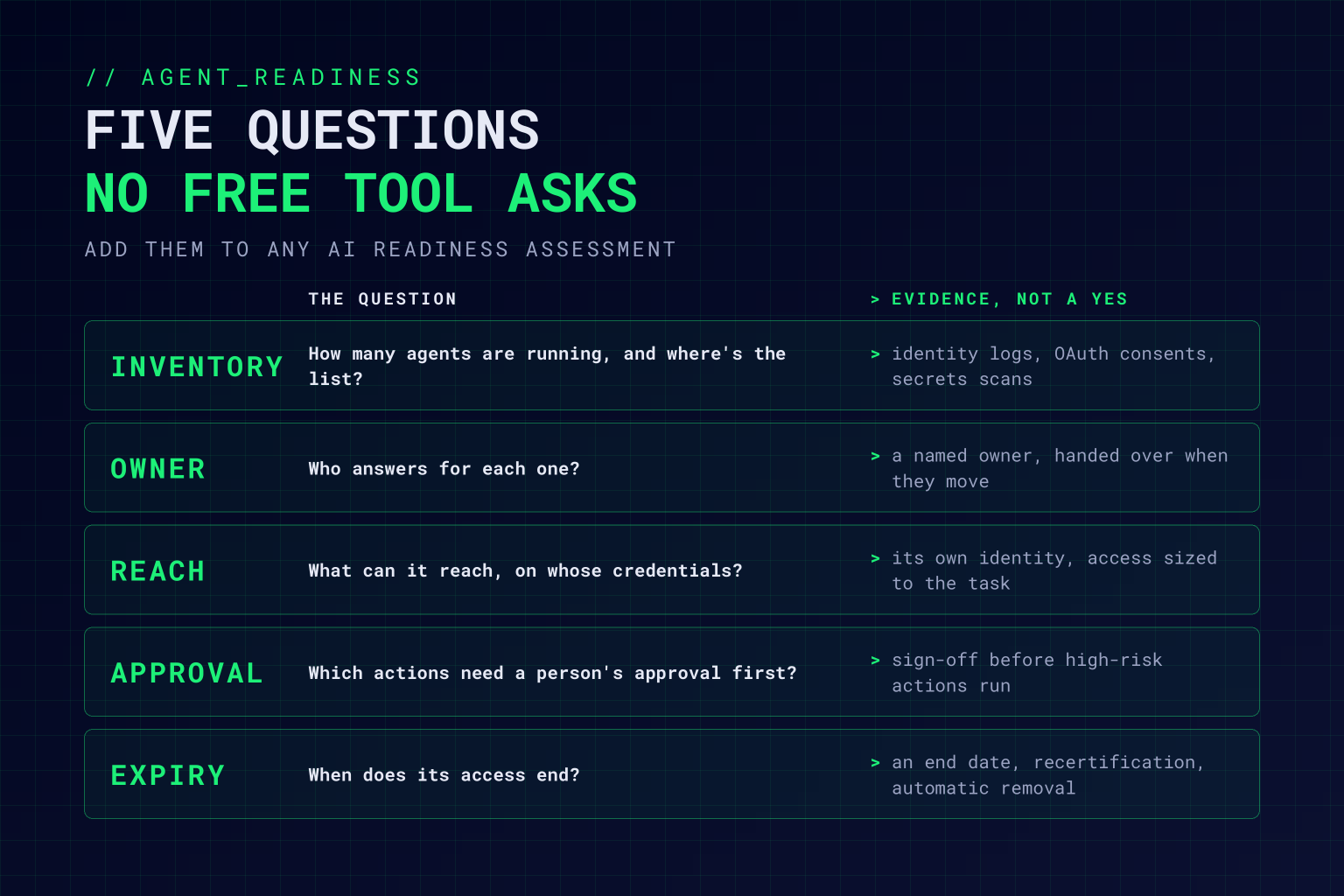
Whichever tool you use, add these five questions. They come from the joiner, mover and leaver lifecycle that identity teams already run for people, and we set them out in full in AI Agents Are Insiders Now. Each one needs evidence, not a yes.
How many agents are running, and where’s the list? If the number comes from asking team leads rather than from your identity provider’s logs, your OAuth consents and your secrets scanner, it’s an estimate.
Who answers for each one? Every agent needs a named owner. When the owner moves or leaves, ownership passes to someone else or the agent is suspended.
What can each one reach, and on whose credentials? An agent should run on its own identity with access sized to its task, not on a borrowed human token or a shared key. We’ve covered why shared agent credentials are so dangerous.
Which actions need a person’s approval before they run? High-risk actions should be approved before they happen, not discovered in the logs afterwards.
When does its access end? Every agent identity needs an expiry date, a recertification cycle and automatic removal when its owner leaves or its project closes.
If you can answer all five with evidence, you’re ahead of most of the organisations Deloitte and SAP LeanIX surveyed. If you can’t, you’ve found the most useful result any readiness assessment will give you this year. Our identity governance case study shows what it takes to automate that lifecycle for people, and agents can join the same one.
How to Get Real Value From a Free Assessment
Answer for the organisation you have. Score what’s true today, not what the strategy says will be true next year. A flattering score is the least useful result there is.
Ask more than one person. Have two or three people answer separately and compare. Where a CIO and a head of data give the same question different answers, the difference is the finding. We made the same point about leaders in The Most Useful Number in AI Readiness Is a Gap.
Treat the score as a hypothesis. Take your weakest area and check it against evidence: the data quality reports, the access reviews, the cost reports. A free tool can point you at a gap. It can’t prove one.
Check what’s already running. A readiness assessment looks forward. If you’ve got models in production, find out whether they still behave the way they did when they shipped. Models don’t fail loudly; as we wrote in Your AI Is Quietly Rotting, they drift.
The best free assessment is the one you answer honestly, check against evidence, and extend to the agents it doesn’t ask about.
Q&A: Choosing an AI Readiness Assessment
What is an AI readiness assessment?
It’s a structured set of questions that scores how prepared an organisation is to adopt AI, usually across strategy, data, infrastructure, skills, culture and governance. Free online versions give a maturity score in minutes. Paid diagnostics check the answers against evidence and produce a roadmap.
Which free AI readiness assessments are available?
Widely used free options include Microsoft’s AI Readiness Assessment on Microsoft Learn (seven pillars, about 45 minutes), Cisco’s AI Readiness Index assessment (six pillars), Thoughtworks’ AI Readiness Assessment (six dimensions and an emailed maturity report), Google’s Gen AI Navigator (strategy, infrastructure and skills), and the Vertex Agility AI Readiness Audit (six areas, including cost management, in about five minutes).
Do AI readiness assessments cover AI agents?
None of the free tools we compared scores AI agents or agent governance. Several score governance in general, but none asks how many agents you run, who owns them, what they can reach, which actions need approval, or when their access ends.
Why does agent governance matter for AI readiness?
Because adoption is ahead of control. Deloitte found only 21% of companies have a mature governance model for agentic AI, while 74% expect to use agentic AI at least moderately within two years. SAP LeanIX found only 49% of enterprise architects and IT decision-makers report even partial visibility into the AI agents in use.
What should come after a free AI readiness assessment?
Check your weakest area against evidence, add the agent governance questions the tools leave out, and check whether the models you already run still behave as they did at launch. A short diagnostic can then turn the findings into a prioritised, funded roadmap.
Working Through This With Vertex Agility
As an AI-native transformation consultancy, we help organisations move from a readiness score to controls that work. Our AI Readiness Diagnostic is a fixed-scope, two-week engagement that checks your data, governance, infrastructure and culture against evidence and produces a phased roadmap with prioritised use cases. Our Onboarding & Assurance Audit maps the models, pipelines and agents you already run and puts monitoring in place where there isn’t any.
If you’d like a quick read on where you stand, our free AI Readiness Audit scores your strategy, data, skills, governance and cost discipline in about five minutes, with a personalised report to your inbox. Then check the models already running with our free AI Health Scan.