

Delivery hit every milestone. The outcome never moved. The post-mortem blamed engineering, because engineering was the only function that produced evidence anyone could read.
Series – this is part 3 of 3 on AI and Cloud consulting. Part 1: Why AI Projects Stall After Cloud Migration. Part 2: How to Buy AI and Cloud Consulting.
That sequence is the standard anatomy of a failed transformation, and the striking thing about it is how well the governance performed throughout. Every board met. Every decision was minuted. Every risk had an owner, a rating, and a mitigation column. The programme died with impeccable paperwork.
Which points at an uncomfortable conclusion. Most transformation governance exists to protect the sponsor, and judged on that objective, it works.
A Risk-Transfer Device With a Calendar Invite
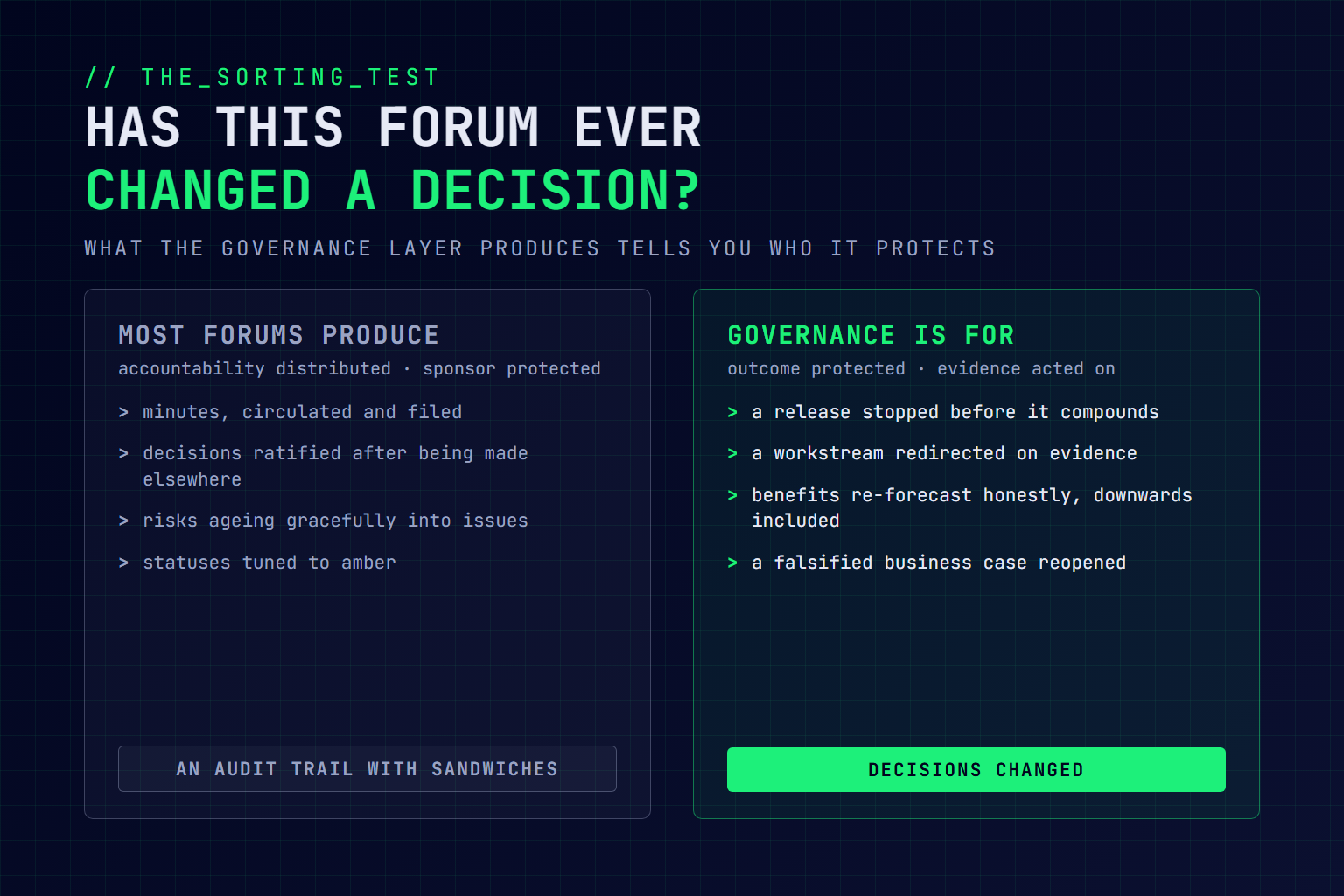
Look at what a typical steering committee actually produces. Minutes. Ratified decisions that were made elsewhere, earlier, by fewer people. A RAID log where risks age gracefully into issues. Status reports tuned to amber, because red triggers scrutiny and green invites budget cuts.
Now look at what those artefacts do. They distribute accountability so widely that no individual holds it. If the programme fails, the record shows the process was followed, the committee was informed, and everyone approved. The sponsor is protected. That protection is what the forum was convened to manufacture, whatever the terms of reference say. A steering committee is a risk-transfer device with a calendar invite.
This isn’t cynicism about the people in the room, who are mostly capable and mostly sincere. It’s a claim about the structure. A forum with no power to stop anything can only ever witness. And a witness, however senior, transfers risk simply by having watched.
The Business Case Nobody Is Measured On
Trace a failed transformation back far enough and you find a business case that was approved against outcomes – cost per transaction down, churn reduced, cycle time halved – and a programme that was subsequently measured on milestones. The outcomes justified the spend. The milestones replaced them the day the spend was approved.
From that point, delivery is measured on milestones, the sponsor is measured on delivery, and nobody is measured on the outcome. Delivery can succeed completely while the outcome quietly dies. This is where digital transformation failures actually begin, and it’s why so many AI consulting projects end up inside them: AI makes the gap wider, because AI benefits are probabilistic and lagging while AI milestones are concrete and photogenic. A model deployed is a milestone. A decision improved is an outcome. Only one of them fits neatly in a board pack.
The Test: Has It Ever Changed a Decision
There is a single question that sorts governance from theatre: in the life of this programme, has this forum ever changed a decision? Stopped a release. Redirected a workstream. Reopened a business case that events had falsified. Sent an estimate back as dishonest.
If the answer is no, the forum is an audit trail with sandwiches, and the programme is being governed by whoever actually makes the calls between its meetings.
We’ve worked under the other kind. On one infrastructure programme we helped protect over £100M of network value for a tier 1 consumer electronics brand. The governance that made that possible had one property most forums lack: it could stop the programme. Nobody wanted it to, and it rarely needed to. The fact that it could is what kept every estimate, every risk rating, and every status report honest.
What a Forum That Changes Decisions Looks Like
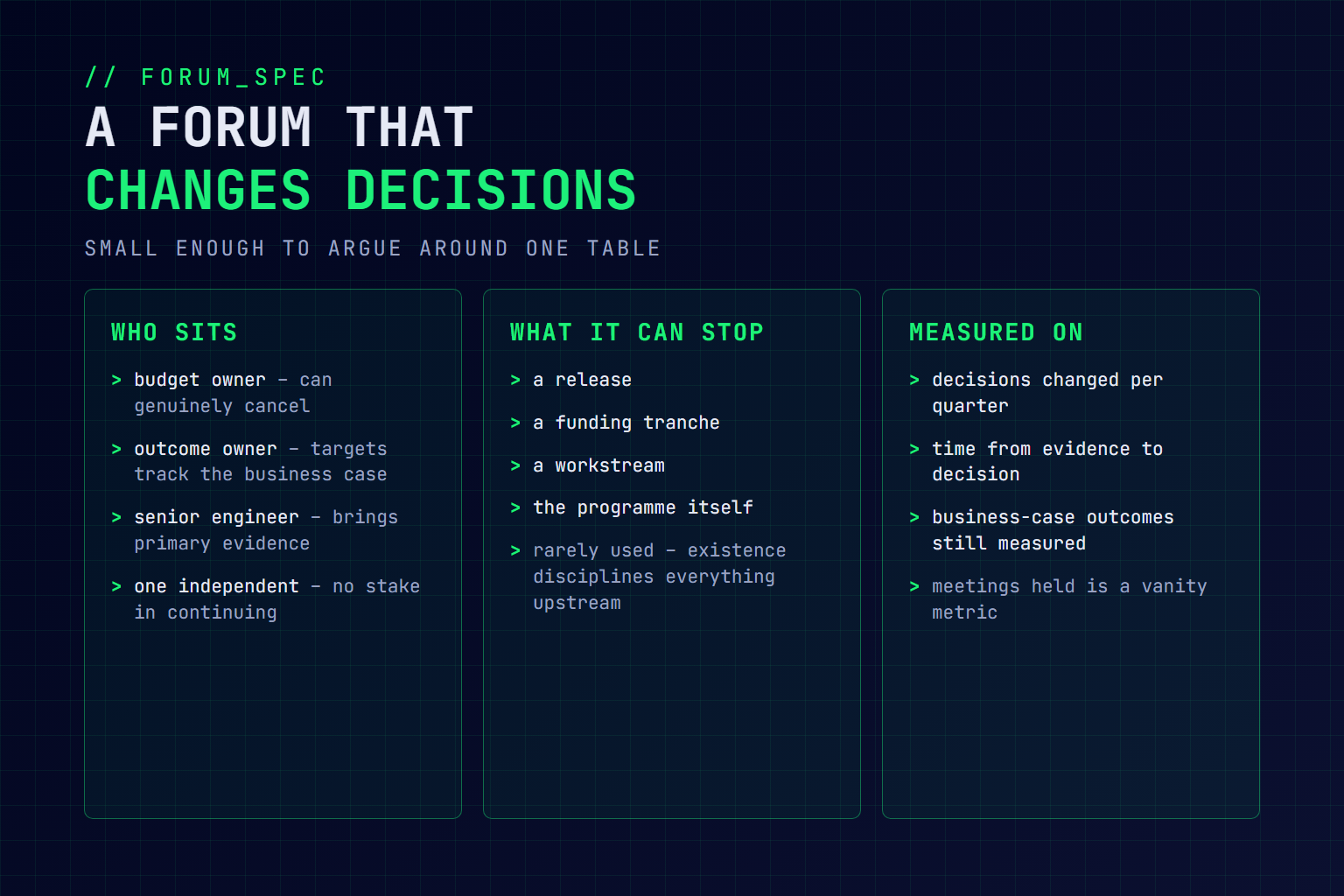
It’s small. If the attendee list needs a second page, the forum is an audience, and audiences don’t decide.
Who sits on it. The budget owner, with real authority to cancel – someone whose signature moves money, and whose own standing suffers if the outcome fails. The outcome owner: the person whose targets track the business-case benefits, which forces those benefits to stay measured. One senior engineer who brings primary evidence rather than a summarised deck. And one member independent of the programme’s success – no delivery bonus, no reputational stake in continuing.
What it can stop. A release. A tranche of funding. A workstream. The programme itself. And its hardest, rarest call: conceding that the platform underneath the transformation is the constraint, the way one of our clients did before re-platforming their technology stack rather than governing a doomed delivery to a punctual failure.
What it’s measured on. Decisions changed per quarter, including the decision to re-forecast benefits downwards when the evidence says so. Time from evidence arriving to decision made. Whether the business-case outcomes are still being measured at all. A forum measured on meetings held will hold meetings. A forum measured on decisions changed will start demanding evidence worth changing them for.
The Objection Worth Taking Seriously
The strongest argument against stop-powered governance is pace. A forum that can halt a programme can also strangle one, and a delivery organisation that fears its governance will start hiding information from it – which destroys the evidence base the forum needs to govern at all. Both risks are real, and both have killed programmes.
The answer sits in how rarely the power is used. Stopping authority works like a central bank rate: its existence disciplines behaviour long before it’s exercised. Estimates get honest when someone can act on them. Ambers turn red earlier when red leads to help rather than blame. The forums that strangle programmes are almost always the ones with unclear authority, because unclear authority gets tested constantly.
And some limits on governance are set before the forum ever convenes. A forum can’t stop what the contract has already committed you to – if the commercial model transferred all the risk to your side at signature, governance is reviewing a sunk cost. That argument belongs to procurement, and we make it in How to Buy AI and Cloud Consulting.
Q&A: Governance That Changes Decisions
Isn’t a forum that can stop the programme just a bottleneck with more power?
It would be, if it operated like a gate on every release. It doesn’t. It meets on a normal cadence, and its stopping power is exercised rarely – the discipline comes from the power existing, which keeps the evidence flowing to it honest. The bottleneck version is what you get when authority is unclear and every decision has to test it.
Who should sit on a transformation governance forum?
Four roles: a budget owner who can genuinely cancel, an outcome owner whose targets track the business-case benefits, a senior engineer carrying primary evidence, and one member with no stake in the programme continuing. Keep it small enough to argue around one table. Observers can read the minutes.
What should governance be measured on?
Decisions changed per quarter, time from evidence to decision, and whether the original business-case outcomes are still being measured. If those three numbers are healthy, milestones can look after themselves. If they’re absent, the milestones are all you have.
Can we retrofit this into a programme that’s already running?
Yes, and the moment to do it is the next funding tranche. Re-approve the business case against outcomes a named person will be measured on, give the forum explicit stopping authority over the tranche after that, and publish what it can stop. Expect one uncomfortable quarter while the reporting adjusts to being acted on.
That closes the series – part 1, Why AI Projects Stall After Cloud Migration, covers who owns the platform after cutover, and part 2, How to Buy AI and Cloud Consulting, covers the commercial model underneath it all.
Working Through This With Vertex Agility
Our AI and Cloud consulting practice is usually engaged inside transformations this article describes, and the engagements that work share one feature: a governance layer that can act on what our engineers surface.
If you want to know whether your own transformation would pass the test above, our free Future Readiness Assessment scores the decision structures around your programme, including the forum that’s supposed to protect its outcome. It takes minutes, and the reading is more honest than the board pack.