

The AI conversation is still about compute: which model, how many chips. The constraint has quietly moved somewhere less glamorous, namely whether your data is in a state a model can actually use.
Walk into most enterprise AI conversations and they open the same way. Which models. How many GPUs. Which accelerators. Those are the exciting questions, and for three years they were the right ones. They are no longer the ones that decide whether your AI works.
The bottleneck has shifted from compute to data, and the evidence is now showing up on balance sheets. Enterprises have spent the past three years buying GPUs faster than they can use them, and a lot of that expensive hardware is sitting idle, waiting on data that is too fragmented, too poorly prepared, or too ungoverned to feed it. Idle GPU clusters waiting on slow, badly prepared data have become a capital allocation problem, and boards have started asking about it directly.
You can see the market repricing around the problem. IDC’s latest storage tracker recorded $9.2 billion in global external storage revenue in the first quarter of 2026, up 22.7% year on year, the fastest growth in years, driven largely by demand for platforms that make data usable for AI. A decade of storage competition was about capacity and price per gigabyte. This cycle is about something else entirely: whether the data is ready.

The Bottleneck Moved. The Budget Didn’t.
Most organisations are still spending as though compute were the constraint. The data tells a different story. A commissioned IDC survey published this summer found that 94% of IT leaders cite data quality as the primary factor determining whether an AI project succeeds. Yet a separate study found only around 14% of organisations consider their data architecture genuinely AI-ready, and more than half report data and storage bottlenecks that limit AI performance. Nearly everyone agrees data quality decides the outcome, and almost nobody has the data in shape to prove it.
There is a simple way to picture the mismatch. Buying frontier GPUs without solving the data problem is like building a state-of-the-art factory and never sorting out the supply of raw materials. The machines are magnificent. They stand still, because the thing they need to run isn’t arriving in a form they can use.
What “Not AI-Ready” Actually Means
The phrase gets used loosely, so it is worth being concrete. Data that isn’t AI-ready usually fails on one or more of four counts.
- It’s fragmented. Spread across silos and systems that disagree with each other, so no model gets a single, coherent view of anything that matters.
- It’s in the wrong form. Locked in formats and structures a model cannot consume directly, requiring slow, manual preparation before it is any use.
- It’s ungoverned. Unclassified and untracked, which means your security and compliance teams are right to be nervous about letting an autonomous agent anywhere near it.
- It’s too slow to deliver. Even good data throttled by pipelines and storage that can’t feed a hungry GPU fast enough, so the compute waits.
Each of these turns an AI initiative from a live system into a science project, and each one leaves that expensive compute underused while someone upstream wrangles a dataset by hand.
Why This Is a Capital Problem, Not Just a Data One
Here is the part that gets a board’s attention. An idle GPU cluster is not a technical footnote. It is capital that was committed on the promise of a return, sitting still because the surrounding data can’t keep it busy. When hyperscalers alone are guiding toward hundreds of billions in AI infrastructure spending this year, the utilisation of that hardware becomes a real number that finance teams will start to scrutinise. The most expensive infrastructure in the building can only ever be as productive as the data feeding it.
That is why the smart money is moving. The surge in storage spending isn’t a hardware refresh, it’s enterprises realising that the competitive question has changed from how much data you can hold to whether that data can be trusted, governed, and served at speed. Governance has quietly become the differentiator, not capacity.
What Making Data AI-Ready Requires
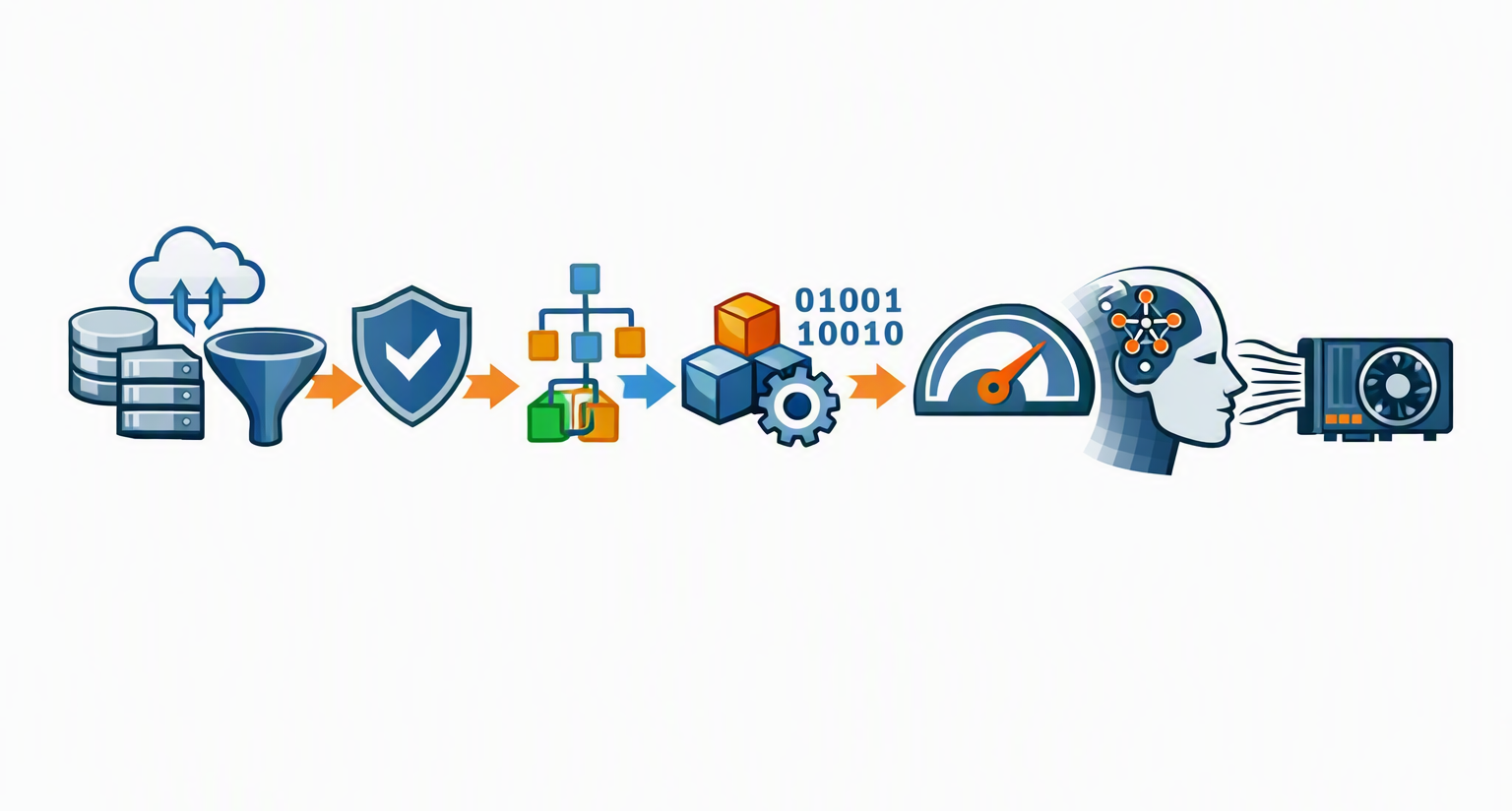
None of this is a single purchase. Faster storage helps, but you cannot buy your way out of fragmentation and poor governance with a box. Getting data AI-ready is architecture and discipline, and it runs along a few lines:
- Consolidate the sprawl. Reduce the number of conflicting sources and give models a coherent, single view of the entities that matter to your business.
- Govern and classify by default. Make governance machine-readable and enforced automatically, so an agent can be trusted with data because the controls travel with it, not because a person signed off once.
- Transform data into forms models can consume. Curate and prepare it so the gap between raw data and usable input is measured in minutes, not months.
- Deliver it fast enough to keep compute busy. Treat throughput and pipeline performance as first-class, because any storage bottleneck becomes a compute bottleneck, which is another way of saying an idle GPU.
- Run it as a stream, not a project. Data should flow continuously into your models and agents, rather than spinning up a fresh multi-month pipeline effort for every new use case.
The Order of Operations Matters
The instinct, when an AI programme underdelivers, is to reach for a better model or more compute. On the evidence, that is usually the wrong lever. If your GPUs are idling, buying more of them makes the problem more expensive, not smaller. The organisations pulling ahead are the ones that fixed the data layer first and let the compute they already owned finally earn its keep.
Q&A: Getting Your Data AI-Ready
Isn’t this just a storage or infrastructure upgrade?
No. Faster storage helps with throughput, but AI-readiness is mostly about fragmentation, governance, and quality, which are architecture and process problems rather than a box you buy. The fastest storage in the world still can’t make ungoverned, unclassified data safe for an agent to use.
We’ve already invested heavily in GPUs. Was that money wasted?
Not wasted, but underused. The research suggests a lot of expensive compute is idling while it waits on data. The return on that hardware is capped by how ready your data is, so the next pound is usually better spent on the data layer than on more chips.
How do we know if our data is actually AI-ready?
Ask whether an agent could find, trust, and use a given dataset without a human stepping in: is it consolidated, classified, governed, and in a form a model can consume, and delivered fast enough to keep the compute busy? Most organisations find the honest answer is no for most of their data.
Isn’t “AI-ready data” just good data governance with a new label?
There’s real overlap, and if you’ve done governance well you’re ahead. But AI raises the bar. Agents consume data continuously and autonomously, so classification, quality, and access controls have to be machine-readable and enforced at speed, not maintained in a document a person occasionally consults.
What’s the first practical step?
Take one stalled or underperforming AI use case and trace it back to the data feeding it. You’ll usually find the blocker there: fragmented sources, missing governance, or a pipeline too slow to keep the model fed. Fix it for that one case, and you have a template for the rest.
Working Through This With Vertex Agility
Closing the gap between the data you hold and the data your AI can actually use is the core of what our Data Consultancy practice does. We build AI-ready data platforms, AI-augmented pipelines, and production ML foundations that connect the data you collect to the decisions you need to make, with governance and lineage architected in from the start rather than bolted on when an agent is already waiting on it. That is the work that turns idle compute into output.
Our AI Consultancy practice sits alongside it. Most AI deployments are performance theatre, and we integrate AI where it demonstrably pays back. Often the most valuable thing we tell a client is that the answer isn’t another model or a bigger cluster; it’s the data layer underneath. Keeping both disciplines together means the data foundations and the AI running on them are designed as one system, which is the whole point.
Because we work across the major cloud and storage providers rather than for any one of them, the architecture we build is the one your data actually needs, not the one a vendor would prefer to sell you.
If you want an honest read on whether your data and infrastructure are ready to put AI into production, our free AI Readiness Mini-Audit covers exactly that ground, with data and infrastructure as one of its five pillars. For a direct conversation about getting your data AI-ready, get in touch with us below.