

The smartest model was never going to be your advantage. The value your organisation creates by using AI is, and right now most of it is flowing straight to your provider.
The AI debate has spent two years asking which model is smartest. This week, the CEO of Microsoft pointed at a better question: who keeps the value your company creates by using it?
In a widely shared post on 13 July, Satya Nadella warned enterprises against tying themselves to a single provider, and argued that control of your own data has to be the priority. His framing was pointed. Model providers take fair-use rights to train on public data, he noted, then turn around and reserve the right to learn from customer usage and interaction data as well. When learning only flows one way, the value pools with whoever owns the infrastructure rather than the people generating the knowledge. His phrase for the fix: every firm should be able to “control their own learning loop.”
That is not a philosophical point. It is a plain description of what is happening inside most businesses right now. Every prompt your staff write, every correction they make, every evaluation they run, and every agent workflow they refine is knowledge about how your business actually works. Under the terms most companies have signed, that knowledge is quietly teaching a model your competitors can rent tomorrow.
Why the Model Was Never the Moat
The leading models have converged. For most business work they are close enough in capability that the choice barely moves the needle, and your competitors can buy the same one on the same day at the same price. So the advantage was never going to come from the model itself. It comes from what you do with it, and from what you learn by using it.
That learning, captured and compounding over time, is the real asset. The trouble is that the default plumbing sends it to your provider, not to you. You get an answer back. They get a signal: what you asked, how you fixed it, which outputs you kept, and which you threw away. Multiply that across an organisation over a year and it becomes a detailed training set describing how you operate.

The One-Way Mirror
This is the uncomfortable shape of a black-box API. You can see what it gives you. You cannot see what it takes. The founder of the open-model platform Hugging Face made the same argument this week: no serious technology company wants to outsource its core capability to a system it cannot see into, control, or own. When the capability that increasingly runs your business sits behind someone else’s API, on someone else’s terms, you are renting the one thing you most need to own.
And the value gap compounds. A provider that learns from millions of customers’ corrections improves a general model that all of those customers, including your rivals, then pay to use. You are funding a competitor’s improvement with your own institutional knowledge, and paying for the privilege.
The Market Is Already Moving
The encouraging part is that owning your own models has stopped being a research project. Open-weight models are taking real production share, and the numbers are not small. Chinese open-weight models made up 41% of downloads on Hugging Face this spring, overtaking US models. On one popular model-routing platform, the six most-used models are all open, with a leading closed model sitting in seventh. On another, open models handled close to a third of all AI requests in June, with closed models increasingly reserved as the premium layer for the hardest tasks.
This is not a claim that open beats closed. It is evidence that keeping your learning in-house is now genuinely achievable. Half of the Fortune 500 already use Hugging Face to deploy private or open models, and a new model repository is created there every seven seconds. Owning or self-hosting a model has become a mainstream option, not a moonshot.

What Owning Your Learning Loop Looks Like
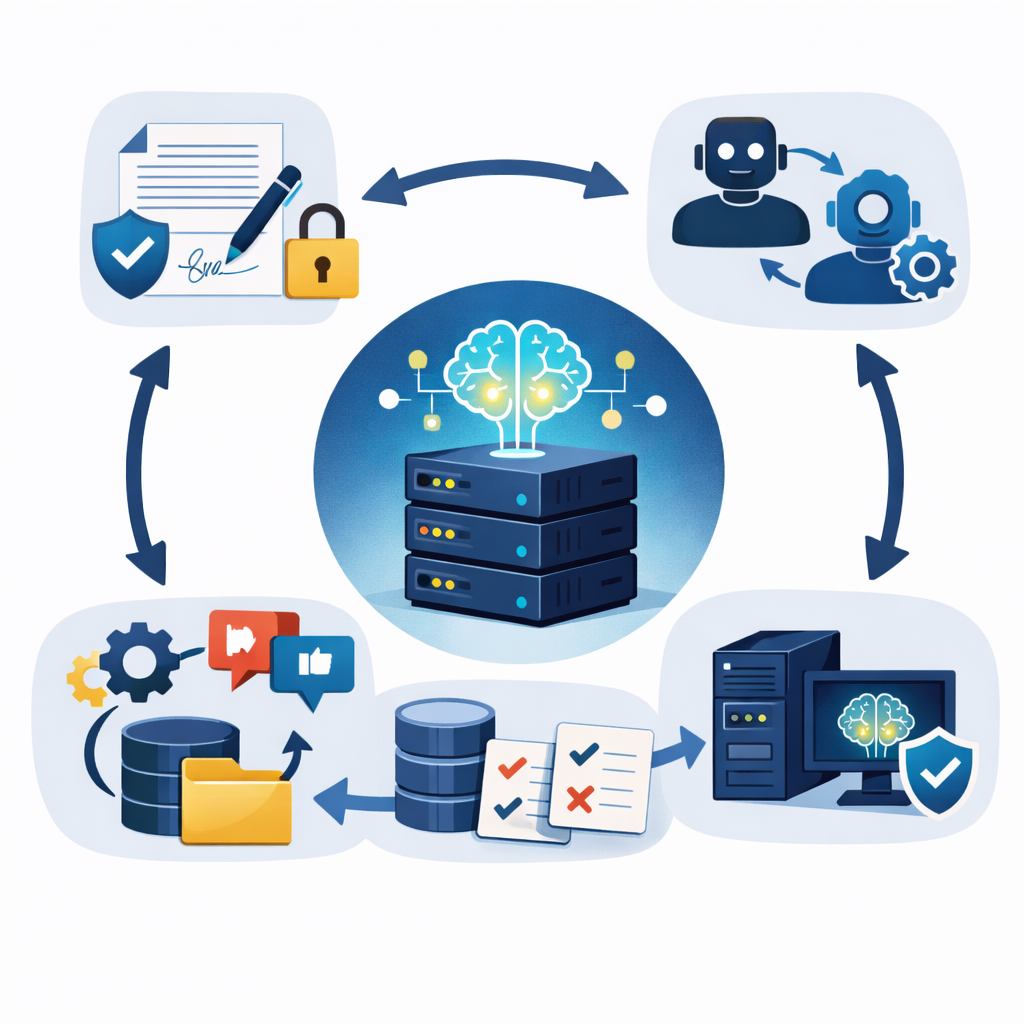
The goal is not to hoard data for its own sake. It is to stop the one-way flow and turn what your teams learn into an asset you keep. A few moves matter:
- Treat your interaction data as proprietary. Prompts, corrections, evaluations, and agent traces describe your business. Decide who can see them, where they live, and whether they can ever be used to train anyone else’s model.
- Fix the contract before the pilot. Most one-way learning is granted in terms nobody read closely. Insist on no-training clauses, clear data-residency terms, and clarity on distillation rights before you scale, not after.
- Build model-portable systems. An abstraction layer between your applications and any model means you can switch providers, and it means the value you build accrues in your layer rather than theirs.
- Own the model where the knowledge is yours. For the workflows that encode real competitive advantage, a self-hosted open-weight model keeps both the data and the learning inside your walls.
- Capture the learning deliberately. Owning the loop isn’t only defensive. The corrections and preferences your teams generate are the raw material for models tuned to your business. Store them, structure them, and feed them back into systems you control.
The Trade-Offs Are Real
None of this is free. Negotiating better terms takes leverage and legal effort. An abstraction layer is engineering that shows no return until the day you need it. Self-hosting a model means owning the tuning, the safety, and the upkeep a vendor would otherwise handle. The real question is whether you would rather carry that cost or keep handing your institutional knowledge to a provider for nothing. For the work that genuinely sets you apart, the maths increasingly favours ownership.
Q&A: Owning What Your AI Usage Creates
Is our data really being used to train these models?
It depends on your tier and your contract. Consumer and default terms often reserve the right to learn from usage and interaction data. Enterprise terms may not, but usually only where you negotiated it. The honest first step is to read what you actually agreed to.
We’re not an AI company. Does this apply to us?
Yes, and arguably more so. The knowledge at stake isn’t AI expertise, it’s how your business runs: your pricing calls, your support patterns, your underwriting judgement. That is exactly the context a provider’s model can learn from your usage, and exactly what you would not want turning up in a tool a competitor rents.
Doesn’t owning a model mean a huge infrastructure project?
Less than it used to. Open-weight models are now capable and mainstream, half the Fortune 500 already deploy private or open models, and hosting one is a manageable engineering effort rather than a moonshot. You don’t have to own every model, only the ones sitting on your most valuable workflows.
Should we stop using frontier models, then?
No. They remain the strongest tools for the hardest and most general work. The move is to stop pouring your most valuable learning into them by default. Use frontier models where they earn their place, and own the loop where the knowledge is yours.
What’s the first practical step?
Two things in parallel: read your current AI contracts for training and data-use terms, and map which workflows generate knowledge you would hate a competitor to have. Where those two overlap is where you act first.
Working Through This With Vertex Agility
Making sure the value of your AI compounds inside your business rather than your vendor’s is the heart of what our AI Consultancy practice does. Most AI deployments are performance theatre. We integrate AI where it demonstrably pays back, and we design the systems so that what your teams learn stays yours. That means model-portable architectures, governance and contractual guardrails on how your data can be used, and self-hosted or open models for the workflows where the knowledge is your advantage.
Our Data Consultancy practice is the other half of the answer. Owning your learning loop only works if the interaction data is captured, structured, and governed in the first place, so we build the AI-ready data platforms, governance, and lineage that turn your AI usage into an asset you hold rather than exhaust you give away. Treating what your organisation learns as infrastructure, not leftovers, is an architecture decision, and architecture is where we start.
Because we work across the major model providers and the open-model world rather than for any one of them, the advice you get is about keeping value and control on your side of the line.
If you want an honest read on whether your technology operation is set up to own and compound the value of its AI, rather than leak it, our free Future-Ready assessment is a good place to start. For a direct conversation about owning your learning loop, get in touch with us below.