

In the same week that Wall Street agreed to bankroll the AI buildout, OpenAI published adoption data showing most enterprises falling further behind the firms that already know how to put AI to work. Read together, the two announcements carry an uncomfortable message: money has stopped being the constraint on enterprise AI. Execution has not.
This week, Nvidia announced memorandums of understanding with Apollo, BlackRock, Blackstone, Brookfield, Goldman Sachs and KKR to establish AI compute infrastructure financing platforms – dedicated pools of third-party capital, intended to mobilise more than $500 billion over time, so that the frontier labs, enterprises and AI clouds in Nvidia’s ecosystem can finance compute rather than fund it from their own balance sheets.
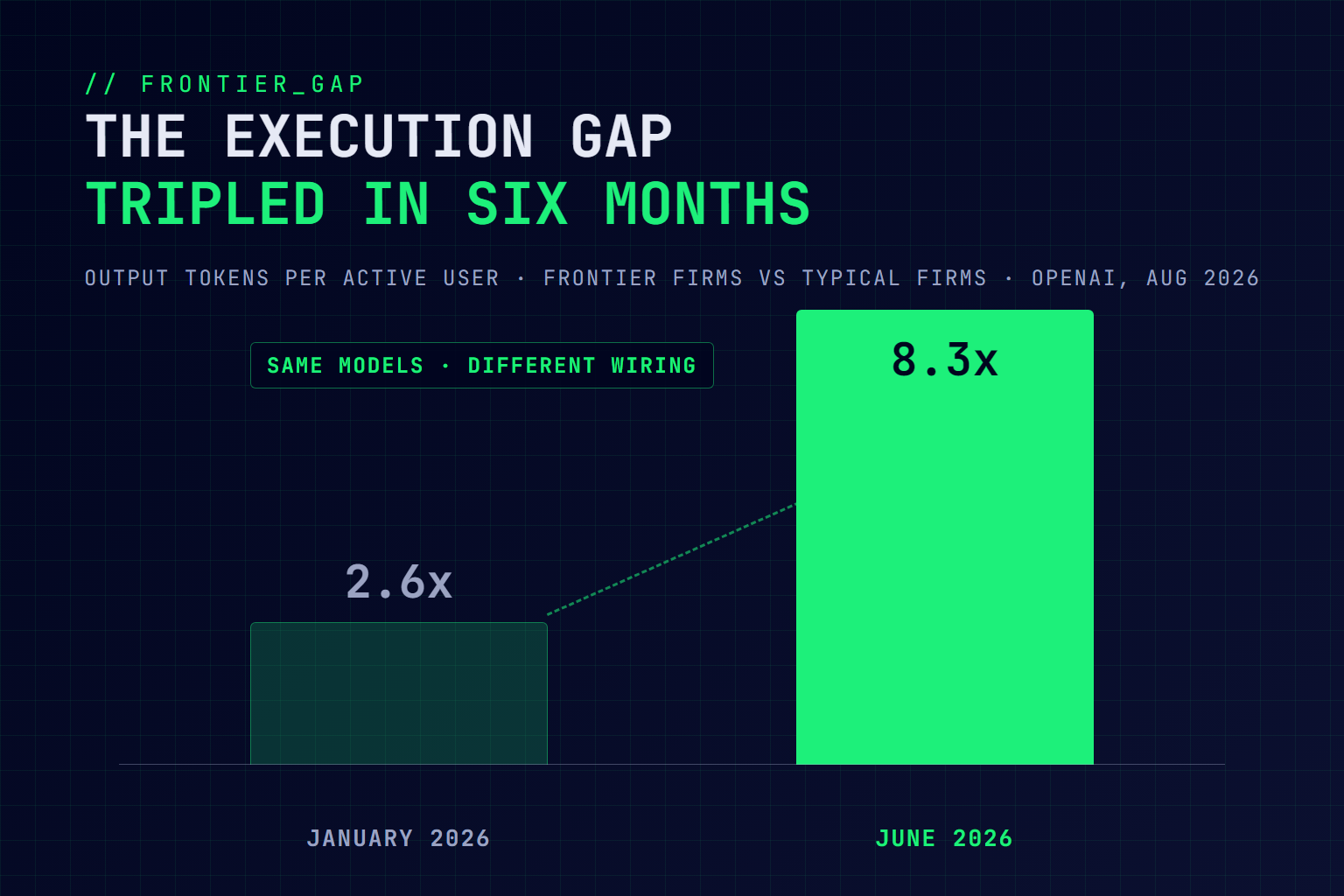
Almost in the same news cycle, OpenAI published a pair of enterprise adoption reports with a very different headline number. Frontier firms – the top ten per cent of organisations by AI usage each month – now generate 8.3 times as many output tokens per active user as typical firms. In January, that multiple was 2.6.
One story is about supply: the machinery of AI has become so fundable that six of the world’s largest investors are building platforms to finance it at global scale. The other is about use: the organisations that already operate AI well are compounding away from everyone else, month after month. When capital queues up to finance the machinery and the leaders keep pulling away on use, the only differentiator left standing is how well your organisation executes.
Compute Is Becoming an Asset Class
The significance of the Nvidia alliance is not the headline figure, eye-watering as it is. It is the structure. Compute is being packaged for institutional capital the way aircraft, shipping and commercial property were before it: specialised financing platforms, dedicated pools at attractive rates, designed so that customers can acquire capacity as a financed asset rather than a capital project.
That is what happens to an input on its way to becoming a commodity. Electricity made the same journey a century ago; cloud infrastructure made it over the past two decades. Once an input is abundant, standardised and financeable, holding it stops conferring advantage, because everyone can hold it on broadly similar terms. Compute is being underwritten like aircraft and property, and that is precisely the moment it stops being a moat.
If your AI strategy amounts to “we will buy access to the best models and the capacity to run them”, this week is the reminder that the same access is now being financed, at scale, for everyone else too.
The 8.3x Gap Is Not a Spending Gap
OpenAI’s metric deserves a moment of attention. Output tokens per active user is a rough proxy for how much work the models are actually doing for each person who uses them. It does not measure licences bought, seats provisioned or pilots launched. It measures use.
On that measure, the frontier is pulling away fast. A 2.6x multiple in January became 8.3x by June. And the research is specific about what frontier firms do differently: they connect AI to company context and tools, they build repeatable agent-driven workflows, and they have moved from assistance – drafting, summarising, advising – to execution, where the system completes defined tasks end to end.
The gap tripled in six months not because frontier firms bought more AI, but because they finished wiring it into how work actually gets done.
You Cannot Finance an Operating Model
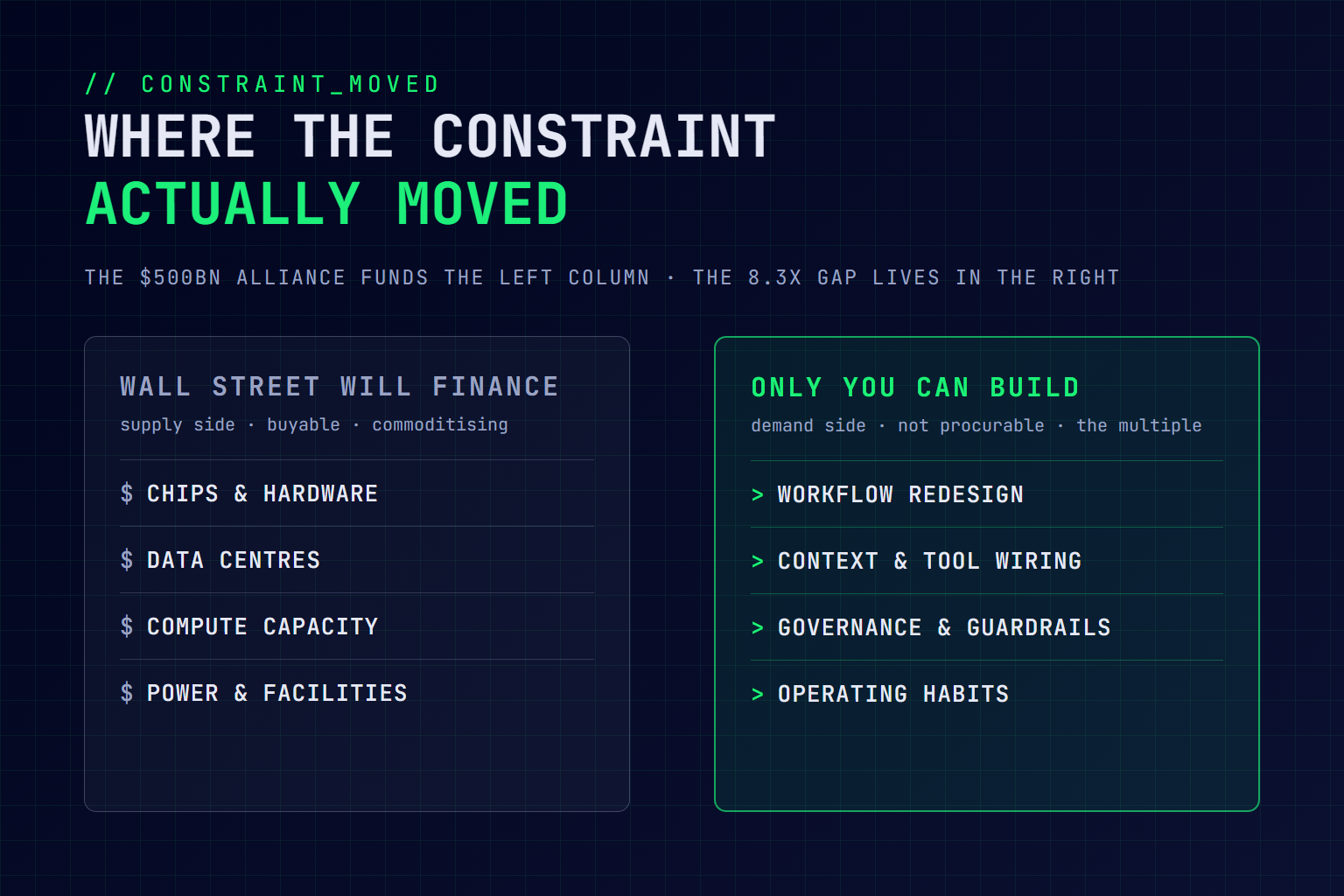
Put the two stories side by side and the division of labour becomes clear. Everything on the supply side of enterprise AI can now be bought or financed: chips, data centres, capacity, power, facilities. Wall Street has just organised itself to make sure of it.
Everything that produces the 8.3x multiple cannot be bought. Knowing which workflows to rebuild first. Giving agents safe access to the systems and context they need. Governance that lets an agent act without a human retyping everything into it. The operating habits that keep usage compounding after the launch announcement fades. These are built, not procured – and they are built inside your organisation or not at all.
There is an uncomfortable corollary. Cheaper, more available compute makes an execution gap more expensive, not less, because every improvement on the supply side accrues fastest to the firms already positioned to use it. A wave of financed infrastructure is about to make the best operators faster, and it will do nothing whatsoever for everyone else.
What To Do While the Capital Is Being Raised
The good news buried in OpenAI’s data is that the frontier is defined by behaviour, not by budget – and behaviour can be copied. Four places to start.
Pick workflows, not pilots. Choose two or three real processes where completion is measurable – claims triage, customer onboarding, invoice matching, release documentation – and commit to moving them from assisted to executed. A pilot proves a model works; a workflow proves your organisation does.
Wire context before scale. The frontier’s edge comes from agents that can see company systems, data and tools. An agent without context produces generic output no matter how good the model behind it is. Connectivity and permissions are the real build.
Measure execution, not adoption. Seats and logins flatter every programme. Track tasks completed end to end, and the exceptions a human still has to catch.
Name an owner. An 8.3x gap is not produced by enthusiasm distributed evenly across an org chart. Someone senior owns the wiring, the guardrails and the number.
Q&A: The Week Compute Became Easy to Buy
What did Nvidia and the six investment firms actually announce?
Memorandums of understanding to establish AI compute infrastructure financing platforms – dedicated pools of third-party capital, targeting more than $500 billion mobilised over time, so that customers across Nvidia’s ecosystem can finance compute capacity rather than fund it from their own balance sheets.
What is the 8.3x frontier gap OpenAI reported?
OpenAI’s enterprise adoption research found that frontier firms, the top ten per cent of organisations by AI usage each month, generate 8.3 times as many output tokens per active user as typical firms, up from 2.6 times in January. It measures how much work AI actually does per user, not how much is spent on it.
If compute is getting easier to buy, why does execution matter more?
Because an abundant, financeable input stops differentiating the firms that hold it. Once everyone can acquire capacity on similar terms, advantage moves to what cannot be procured: redesigned workflows, agents wired to company context, working governance and sustained operating habits.
Where should an enterprise start closing the execution gap?
Pick a small number of real workflows and move them from assisted to executed, wire agents into company context and tools before scaling seats, measure completed work rather than adoption, and give the programme a senior owner. A structured playbook and an honest baseline assessment shortcut the first two steps.
Related reading – The Demo Was the Easy Bit picks up where procurement ends, and The demo was the easy bit… makes the production-workflows case in full.
Working Through This With Vertex Agility
Execution gaps are where our AI consultancy practice spends most of its time – not model selection, but the workflow redesign, context wiring and governance that turn purchased capability into completed work. We are implementation-first for the same reason OpenAI’s frontier firms are: that is where the multiple lives.
Two free places to start. The Generative AI Implementation Playbook is the workflow-first method for moving from pilots to executed processes. The AI Readiness Mini-Audit gives you an honest baseline in about fifteen minutes – a maturity scorecard and a personalised report showing which side of the execution gap you are currently on.