

By the time a buyer’s diligence team opens your data room, the headline price has already been agreed. Everything that team finds from that point on moves the number in one direction only. The uncomfortable part: almost all of it was findable six months earlier – by you.
Deals are being underwritten more carefully than they have been in years. Buyers verify more and assume less, diligence timelines have stretched, and technology has moved from an appendix in the process to one of the workstreams that decides whether the deal completes on its agreed terms.
Yet most sellers still prepare for technology due diligence the way people prepare for a surprise inspection: they tidy up what’s visible and hope. The businesses that defend their valuation do something different – they run the buyer’s checklist against themselves before the buyer does.
Diligence Doesn’t Discover Value. It Discovers Reasons to Reprice.
A technology diligence team isn’t there to admire the product. Their brief is specific: find the costs, risks, and dependencies the agreed price doesn’t yet reflect. Every finding lands in a report, and that report negotiates against you – as a price chip, a warranty, an escrow holdback, or an earn-out structure that quietly transfers the risk back to the seller.
None of this is underhand. It’s what disciplined buyers are supposed to do. The asymmetry is that the buyer arrives with a trained checklist and the seller often arrives with a pitch deck. The diligence report is the only document in the deal written by someone with no incentive to like your business.
The Flags Are Boring. That’s the Point.
Ask people what kills deals and they imagine dramatic discoveries. The reality is a short list of unglamorous findings that appear in report after report: one engineer who is the only person who can release the core system. A revenue-critical platform that exists as code plus oral tradition. A dependency scan that surfaces copyleft licences in proprietary code and components years past end-of-life. A security posture described as serious but evidenced by nothing. Headline metrics in the deck that nobody can reproduce from source data inside a week.
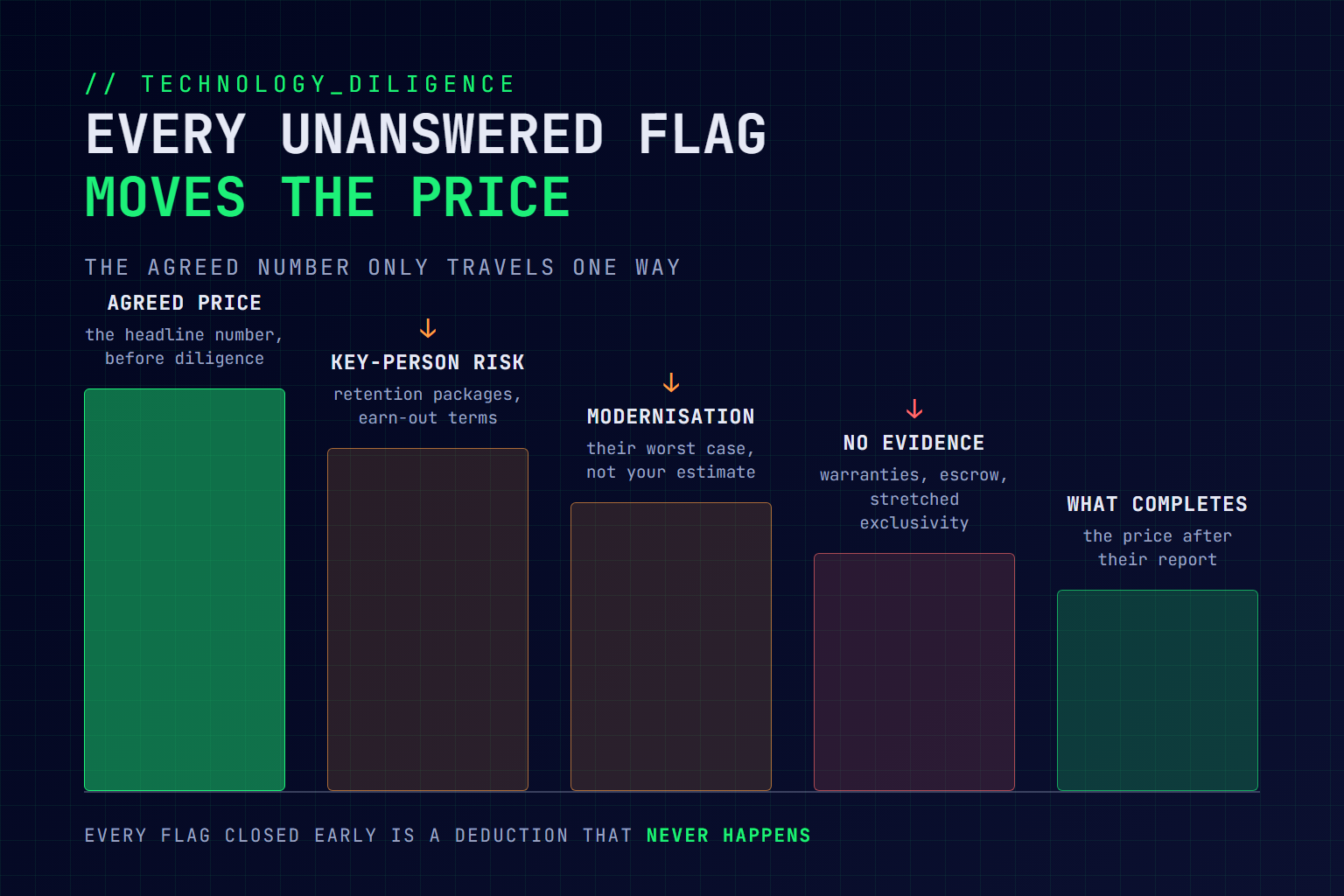
Each flag feels like an engineering problem. Each is priced as a negotiation position. Retention packages, remediation workstreams at the buyer’s consultants’ day rates, integration plans that stretch by quarters – all of it is subtracted from proceeds. The flags are individually mundane and collectively expensive, which is exactly why diligence teams are briefed to look for them.
The Newest Question on the Checklist: Your AI Posture
Since 2024, a new section has appeared in nearly every technology diligence pack, and most sellers still have no answer prepared. Where does AI already touch your product and your delivery process? What’s exposed – customer data in third-party tools, model output of uncertain provenance in the codebase, staff using unapproved assistants? And where is the opportunity the buyer intends to underwrite?
It cuts both ways. Ungoverned AI use gets priced as risk. But no AI story at all is now priced as a growth-case gap: buyers underwrite AI-enabled margin improvement as standard, and a seller who can’t speak to it concedes that upside to the buyer’s plan rather than their own multiple. A one-page AI position – where it is used, under what controls, and where it changes the unit economics – is currently the cheapest valuation defence available to any seller.
Whoever Writes the Estimate Wins the Negotiation
The pattern underneath every flag is the same. Undocumented, unquantified, unevidenced things get priced at the buyer’s worst case – because the buyer’s estimate is the only number in the room. A modernisation backlog you could schedule for a fraction of their figure becomes a headline deduction, purely because your board has never seen a costed version of it.
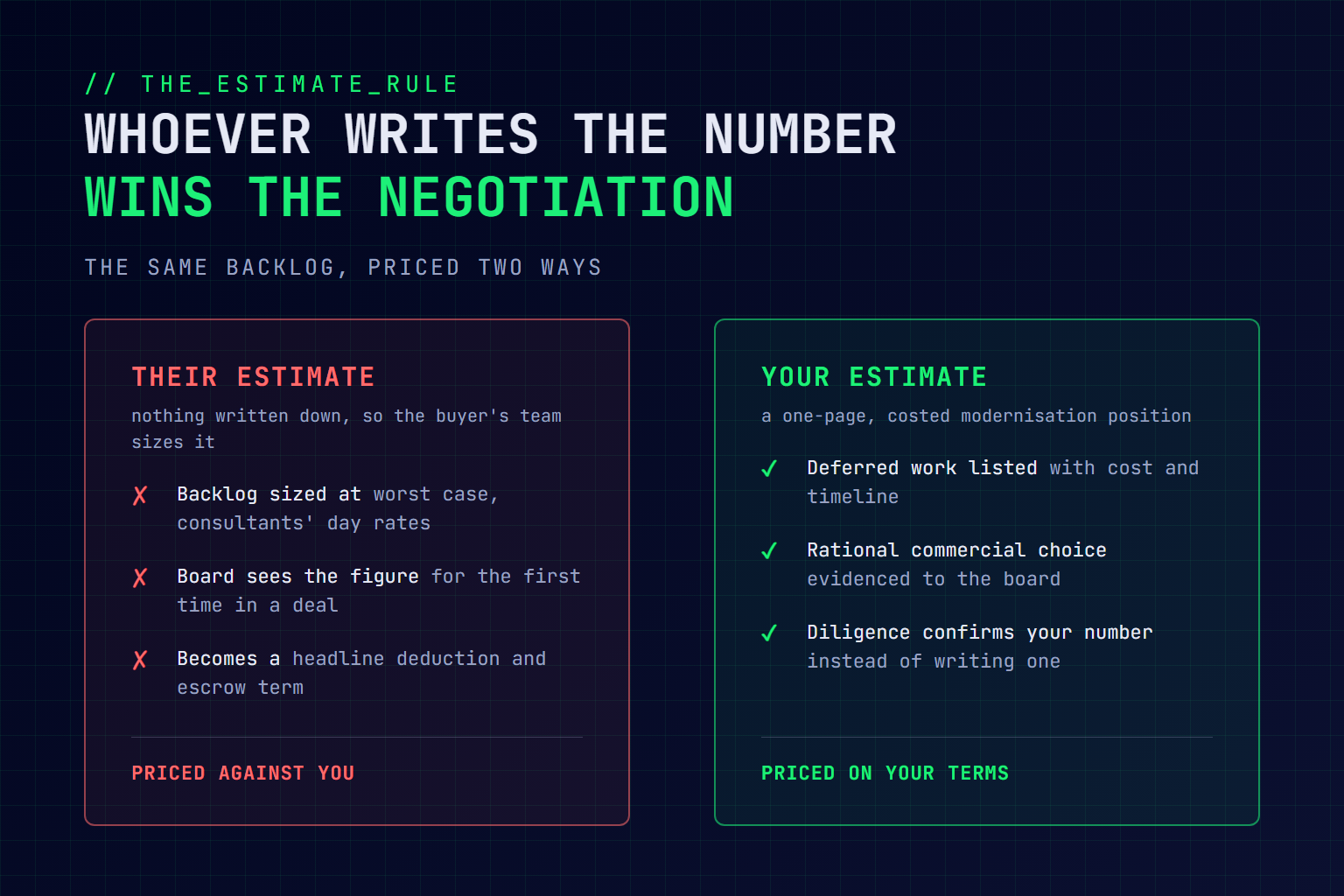
Preparation, in the end, isn’t about fixing everything before a process. It’s about making sure every known weakness arrives with your number attached, your rationale written down, and your plan on the table. Buyers respect evidenced positions; they punish surprises.
Q&A: Deal-Ready Technology
What is technology due diligence actually looking for?
Costs, risks, and dependencies the agreed price doesn’t yet reflect: key-person concentration, undocumented core systems, licence and dependency exposure, deferred modernisation, release capability, security evidence, the reproducibility of headline metrics, and – increasingly – the organisation’s AI posture. The findings feed the buyer’s negotiation position, not just their report.
When should a seller start preparing for technology due diligence?
Six to twelve months before a process, because the cheap fixes take that long: documentation of the core, succession on critical systems, licence hygiene, a costed modernisation paper, and an AI position statement. Started early, this is ordinary engineering work. Started during exclusivity, it’s a concession.
What are the most common technology red flags in due diligence?
Key-person concentration and undocumented core systems appear most often, followed by licence and dependency exposure, an unwritten modernisation bill, release processes that make change slow and risky, security postures with no artefacts behind them, and deck metrics that can’t be rebuilt from source data. Missing AI posture is the fastest-growing entry on the list.
Do buyers really care about AI posture yet?
Yes, in both directions. Ungoverned AI use is priced as data, IP, and regulatory risk. But the larger effect is on the growth case: buyers now underwrite AI-enabled improvement as standard, so a seller with no credible AI story hands that upside to the buyer’s plan instead of pricing it into their own multiple.
Related reading – the flags buyers price into a deal are the same ones a modernisation removes: Modernise the Bank Without Betting the Bank.
Working Through This With Vertex Agility
Our Technology Due Diligence & Value Creation practice is run by senior operators who have taken technology through deal processes on both sides of the table – scoping diligence for buyers, and preparing sellers to walk through it without surprises. Engagements are fixed-scope and start small: a deal-readiness review that walks the known red flags through your actual estate, evidences what’s already strong, and gives the board a costed plan for what isn’t, with an AI-readiness lens on everything as standard.
If you want to see your business the way a diligence team will, start with the checklist they use: download the free Deal-Ready Technology Red Flags – eight flags, one page each, twenty-four self-checks you can run this week.