

The final workload has been cut over, the legacy servers are officially powered down, and the project team has shared a celebratory drink. On paper, the migration is a success. But three months later, a different reality sets in. The CFO is asking why the monthly cloud bill is higher than the previous data centre costs, and the engineering team is complaining that “the cloud” is actually slower than what they had before.
Related reading – the run-up to this: Why Most Cloud Migrations Stall – and the Strategy to Keep Yours on Track. And the ownership argument for what comes next: Why AI Projects Stall After Cloud Migration.
This is the Post-Migration Hangover. It happens when an organisation treats the cloud as a destination rather than an operating model. If your migration strategy was purely about “getting there,” you likely moved your technical debt along with your data.
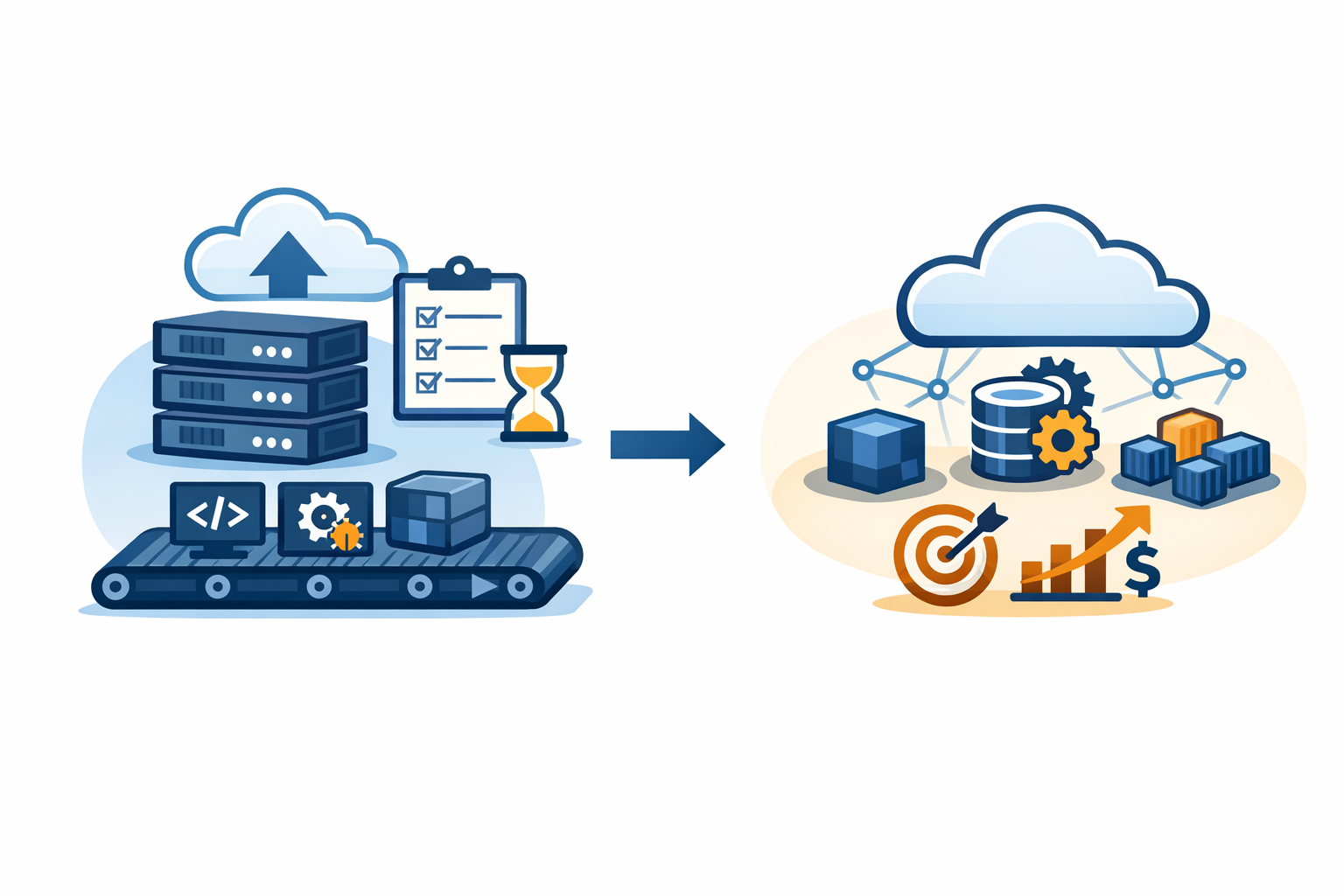
To turn a stalled or underwhelming migration into a long-term win, you need to shift your focus from Day 1 (Deployment) to Day 2 (Optimisation). Here is how to stop the “lift and shift” regret before it sets in.
1. The Rightsizing Reality Check
In a traditional data centre, over-provisioning was a survival tactic. If it took six weeks to rack a new server, you bought the biggest one possible to “future-proof” the application. In the cloud, that same habit is a recipe for financial disaster.
Many organisations “Lift and Shift” their workloads using a 1:1 mapping – taking a massive on-premises VM and plopping it into an equally massive cloud instance. The result? You are paying for CPU and RAM that you never actually use.
The Fix
Implement a rigorous rightsizing exercise within the first 30 days. Use native cloud monitoring tools to identify “zombie” instances and downsize resources to match actual demand.

2. From “Ticket Culture” to Self-Service
One of the most common reasons cloud migrations fail to deliver agility is that the organisation’s internal processes haven’t migrated. If an engineer still has to raise a manual ticket and wait three days for a security group change, you aren’t “in the cloud” – you are just using someone else’s data centre with a slower interface.
To capture the true value of the cloud, you must move from being a “gatekeeper” to a “guardrail” provider.
The Fix
Focus on Policy as Code. Instead of manual approvals, bake your compliance and security requirements into your deployment pipelines. This allows your teams to move at speed while ensuring they can’t accidentally “break” the environment.
3. The Modernisation Backlog: The 6Rs Re-visited
As we noted in our previous article, the “Rehost” (Lift and Shift) approach is often the fastest way to migrate, but it is rarely the most efficient. The real “Cloud Alpha” – the significant performance and cost gains – comes from Refactoring.
Once you are in the cloud, your “Rehosted” applications should be viewed as temporary. They are now part of a Modernisation Backlog.
The Fix
Prioritise workloads that would benefit most from cloud-native services. Moving from a self-managed SQL server to a managed database service (like RDS or Azure SQL) reduces the operational burden on your team and instantly improves resilience.
4. Establishing a FinOps Rhythm
Cloud spend is variable, which is a double-edged sword. While you only pay for what you use, it is very easy to use much more than you planned. “Cloud Shock” usually occurs because there is a disconnect between the engineers spinning up resources and the finance teams paying for them.
The Fix
Treat FinOps as a continuous loop, not a quarterly review. Give engineers visibility into the costs of the systems they build. When a developer can see that their experimental cluster is costing £500 a day, they are much more likely to turn it off when they go home.
Don’t Start on the Back Foot
The most successful migrations don’t happen by accident; they are the result of a “Day 2” mindset established before the first workload even moves. If you are finding that your migration is stalling – or if you’ve arrived in the cloud only to find it isn’t the panacea you expected – it’s time to go back to the fundamentals.
Our Cloud Migration Readiness Checklist was designed to help you spot these “Day 2” traps before they become expensive mistakes. It provides the structured framework you need to ensure your security, finance, and engineering teams are all reading from the same script.
Download the free Cloud Migration Readiness Checklist now